Sunday 31st August [Sunshine & heavy showers]
I wanted to take some pictures of the Osprey today, but the weather conspired against that this afternoon. All the while I was at the lake, it was standing on a branch exposed on the lake bed – as it has for several days. From the hide I counted three Greenshank, five Lapwings, seven Great White Egrets and 11 Grey Herons, noted three Wigeon among the dabbling ducks, saw a Peregrine and Hobby over Top End, and was quite impressed with the number of hirundines feeding over the water in the heavy showers, although a few of them landed on the shore at times. The three Egyptian Geese were back on the dam as I headed home mid-afternoon.
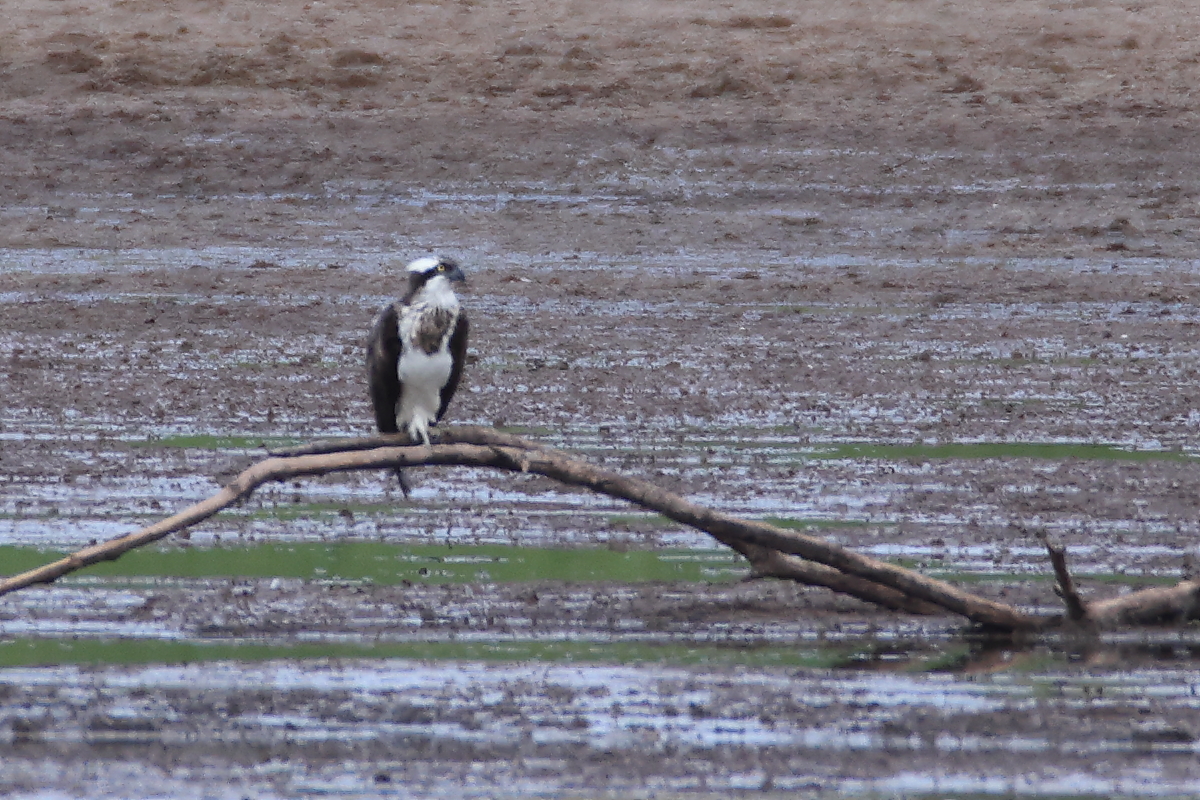
Adult female Osprey, Top End, Blagdon Lake © Nigel Milbourne 2025
Saturday 30th August [Dry morning with showers later]
I was at the lake fairly early this morning and saw 3 Egyptian Geese and a Common Sandpiper at Butcombe Bank. Later, I saw the Osprey, a Kingfisher, an adult Yellow-legged Gull, a Pochard, six Lapwings and four Greenshanks from Rainbow Point. I counted 20+ Moorhens, 36 Little Grebes, and nine Little Egrets. In the evening, I watched ten Great White Egrets and the Osprey go to roost in Indian Country pines. The Osprey intrigued me because it chose the same perch as the bird that stayed for a while last autumn, to roost and feed on. Could it be the same bird using the lake as a staging post during migration? Just before I left, I watched an Otter running across the exposed lake bed to the water where it made its way through the weed to open water.
The second bit of exciting news I promised yesterday, was that Just before I went away, I saw an Asio Owl sp. hunting at the lake at 2035 hrs on 18th August. It was flying low over a meadow that had recently been cut for hay and made several dives into the mown grass that was lying on the ground drying out. I noted that it was streaked on the upper chest, had orange eyes, and a large orange area in the upper wing. I didn’t see the tips of the underwing though. As it was nearly dark and hunting at this time of year, coupled with the orange feather tones and eyes I thought that, on balance, it was probably a Long-eared Owl. I had the pleasure of watching it for about five minutes over a ten to fifteen minute period. I told our owl team, Chris Sperring, Melanie P. and Mark H. Chris and Melanie were unable to come for a look the following eveing, so I decided to postpone my trip to Scotland for a day and arranged to meet Mark. At 2035 hrs the bird reappeared in the same place and we watched it hunt for maybe ten to fifteen minutes in the gloom. Critically, this time, it decided to perch on a post a couple of times which gave Mark the opportunity to get some very dark photos. He sent some to me later that evening and with some editing I was able to take a closer look at the plumage. Despite its behaviour, I began to suspect that it might be a juvenile Short-eared Owl after all. I shared the photos with Chris and we discussed them the following morning. Neither of us were absolutely sure of the birds identitiy, because head on the bird looked like a Shortie with orange eyes, side-on it looked like a LEO, and with it hunting at dusk and the time of year surely it was more likely to be the latter? However, one heavily barred feather tract in Mark’s pictures made me think it might be a Shortie. Either way, Chris told me he was very excited about the record, given how poorly owls have done in our region this year, and came for a look with Melanie the next evening. I had to go to Scotland so couldn’t join them. I gave them details of where and when to look for the bird and kept my fingers crossed. Well, long story short, they came across the bird hunting while they were walking to the spot where I’d seen it twice, and they had it in much better light than Mark and I’d seen it. They got some photos and a short video clip which proved that it was a SHORT-EARED OWL – the third lake record, the previous two being in 1945 and 1947. We elected to keep quiet about the sightings with its being a juvenile, and not knowing where it was roosting, until we knew more about it. Unfortunately, it hasn’t been seen again since the 20th, despite Melanie looking for it while I was away, and me looking for it since I got back home. The big question for us all is where had it come from, as it had surely fledged locally? I was surveying Black Down this summer for the BTO with Skip and Dave, and we hadn’t come across any hunting Asio owls, so its origin remains a bit of a mystery.
Friday 29th August [Breezy, mainly dry, & sunny.]
I was at the lake for 0900 hrs with Mark H., Ken A., Georgina and Nat to check the bat boxes. We counted at least 98 Soprano Pipistrelles, but there were several boxes rammed with them that we were unable to count – so well over one hundred were seen during the day. While we were beavering away at the dam end, Merv. P. was birding and reported the Osprey at Top End again, three Greenshank, and a Spotted Redshank, all of which I caught up with later in the day. However, I have some quite exciting news to pass on over the next few days, starting with a report today of the first proven record (photographed) of a Dipper at the lake since they used to breed back in the 1920-30’s (last record in 1932). There have been several claimed sightings over the last few years, but most of these refer to a wintering Green Sandpiper that has been present for the last two years. Sadly, from a bird watching point of view, today’s report comes from a part of the BW estate that is not open to the public, with or without a permit.
Thursday 28th August [Sunshine & thundery showers]
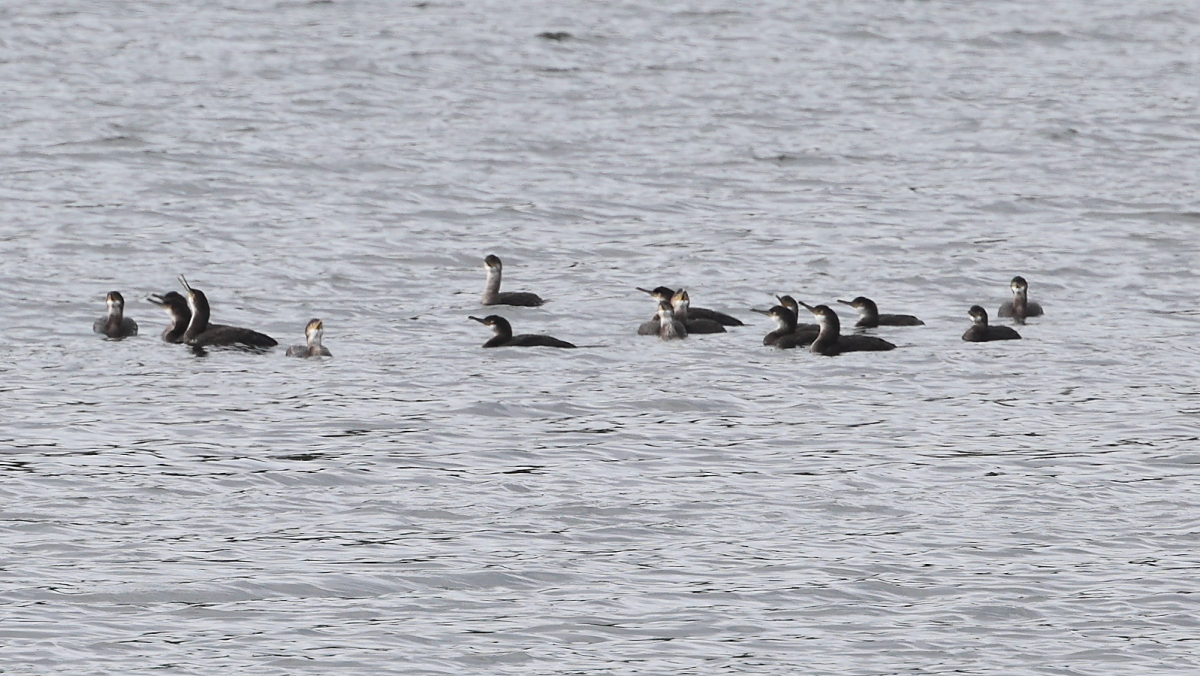
Apologies for the lack of news updates, I’ve been away in Scotland, and had little time to feed the snippets received from various correspondents onto the website. I will put this right over the coming day or so, now that I’m back home. This morning there was a report of an Osprey on the mud at Top End from Rich M. and it was still there when I went to the lake this afternoon. As I drove towards Top End, I spotted a SHAG swimming east just off the North Shore, so decided to stop at Rainbow Point in the hope of a closer look and a photo or two. It wasn’t to be, but I noted the Osprey still standing on a log in the middle of Top End so went to the hide to grab some pictures of it. When I went back to look for the Shag, I was completely flabbergasted to see a flock of 32 just off Rainbow Point. Had they been brought down onto the water by the heavy thundery showers? Rich M. and Andy D. joined me and we certainly chuckled as the whole flock made their way through the weed onto Rugmoor, where they waddled around like Penguins! Before I left at around 1830 hrs it seemed like they might have moved on. In addition, I counted four Greenshanks, seven Snipe, a Ruff, six Lapwings, 35 Little Grebes, two Swifts, nine Great White Egrets, eight plus Little Egrets and a juvenile Cattle Egret.
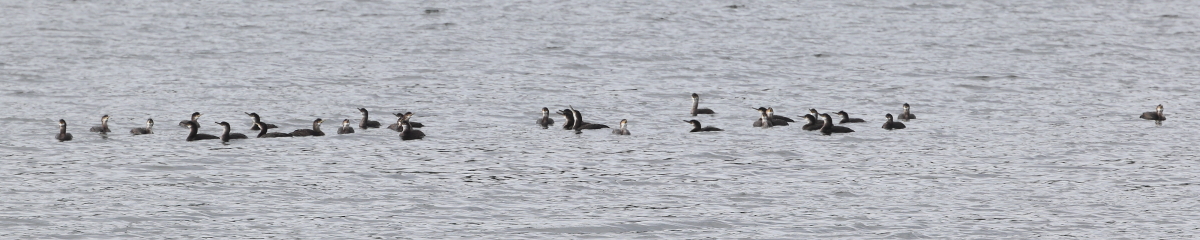
The flock of European Shags, Blagdon Lake © Nigel Milbourne 2025
Footnote: It seems that the flock of SHAGS on the lake today is the largest recorded in the Avon area, either inland or on the estuary, although I recall Dave Northover and his wife telling me they’d seen a flock at the lake several years ago, the record of which doesn’t seem to have been submitted, or accepted.
Another footnote: I had a verbal report today of a sighting of a “massive bird” seen over Yeo Valley farm mid-morning, that may conceivably relate to the introduced male White-tailed Eagle (G717) that’s been at Chew Valley Lake for the last few days, but that’s just conjecture.
Tuesday 26th August
More news from Merv P. during a visit between 1115 – 1400 hrs; one Common Sandpiper on the dam, five Greenshanks, four Ruff, nine Black-wits, one Wood Sandpiper, and an Osprey in the Indian Country pines.
I managed to find a couple of hours to go to Musselburgh Lagoons to look for the Velvet Scoter flock at high tide, but no luck again. I saw Sandwich Terns, gulls, Common Seal, Oystercatcher, Common Eider, Goosander, Mallard, Mute Swan, Cormorant, Guillemot and Razorbill, to name but a few spp.
Monday 25th August
News from Martin K. of seven Glossy Ibises at Top End, and Nick P. reported them, a Wood Sandpiper and nine Greenshank. Andy D. reported the Osprey as well. Avon Birds reported 19+ Great White Egrets.
Sunday 24th August
News from Merv P. from a visit between 0700 – 0900 hrs: one Kestrel, one Wood Sandpiper, three Ruff, five Black-wits, one Peregrine, 13 Greenshanks, one Redshank, two Spotted Redshanks, and one Cattle Egret. Ross F. Sent me news of a Red Kite over the dam end this afternoon. Osprey at Top End per Nick P. (photo), plus 36 Little Grebes, twelve Black-wits, a Wood Sandpiper, eight Greenshanks, three Ruff, a Wood Sandpiper, a Marsh Harrier, eleven Snipe, and six Common Sandpipers.
Saturday 23rd August
News posted on Avon Birds: A Wood Sandpiper and a Spotted Redshank.
Friday 22nd August
News from Merv P. from an early morning visit 0715 – 0900 hrs: most of the birds are at Top End. 11 Greenshanks, six Black-tailed Godwits, five Snipe, five Ruff, two Ringed Plovers, two Lapwings, and seven Buzzards.
Thursday 21st August
News from Nick P. of seven Snipe, eight Greenshank, one Green and three Common Sandpipers, a Wood Sandpiper, three Ruff, and four Black-tailed Godwits.
Wednesday 20th August
News posted on Avon Birds: Three Black-tailed Godwits, 12 Greenshank, and two Ruff.
Tuesday 19th August [Sunny spells, overcast in evening with spots of rain.]
I went down to the lake a couple of times today, lunchtime and evening, and saw four Lapwing, four Black-tailed Godwits, two Common Sandpipers, ten Greenshank, the Ruff and Reeve, 25 Great White, at least 20 Little, and six Cattle Egrets, of note. 43 spp. Later, I received a video and still picture of a Reeve’s Pheasant taken by neighbour Clare in one of the local woods. However, as there are also pheasant pens for the shoot, Guineafowl and Peacocks wandering around too, I’m not overly surprised. It was an excellent spot though. Thanks Clare.
Monday 18th August [Overcast in the morning, brightening a little later on.]
There was news and photographs of a Glossy Ibis at Cheddar Reservoir this morning, and one photo showing feathers standing out from the back or side that reminded me of what I had seen at Blagdon. So, it was no surprise that I couldn’t find the bird at the lake this evening – I guess it’s the same individual. Back at the lake there had been a small arrival of waders including a Ruff and Reeve, six Green Sandpipers, five Black-tailed Godwits, plus the eight Greenshank and two of the Lapwings that I saw yesterday. At the dam end, I counted three Common Sandpipers. Egret numbers were down, with just 22 Great White and 12 Little Egrets gathered pre-roost. 35 spp. The water level is now below 45% at the lake and, good news, the meadows on the south side of the lake are being cut.
Sunday 17th August [Breezy, hot & sunny.]
The GLOSSY IBIS was still present until mid-afternoon at least, and I counted eight Greenshanks, one Redshank and four Lapwings scattered around the waterside. An ‘at least’ count of egrets included 27 Great White’s, ten Little and two Cattle Egrets. An adult Yellow-legged Gull was a welcome find too. I plan to go back later, when it gets a bit cooler. Later: I counted seven Common Sandpipers, the GLOSSY IBIS was present until dusk, and 37 Great White and 21 Little Egrets gathered pre-roost at Top End. 42 spp.
A Red Kite reported over the dam end per Ross F.
Saturday 16th August [A warm breezy day]
I did another Parkrun at Five Arches, Radstock this morning, and decided to go to the lake this evening, rather than during the afternoon. The GLOSSY IBIS was present all day, and I watched it until sunset, but I didn’t see it go to roost. I counted 33 Little Egrets before they flew off in dribs and drabs to t’other place. Perhaps it went with them. I also counted 25 Great White Egrets then, as I drove back towards the dam end, another five Great White’s flew up the lake with a darker bird that I couldn’t identify in the poor light at 2045 hrs. So, there were 30 Great White’s. I also counted eight Greenshanks and three Common Sandpipers. I received news of a Peregrine and two Hobbies seen during the day as well. The water level continues to drop noticeably and recedes further from Top End hide day by day. 30 spp.
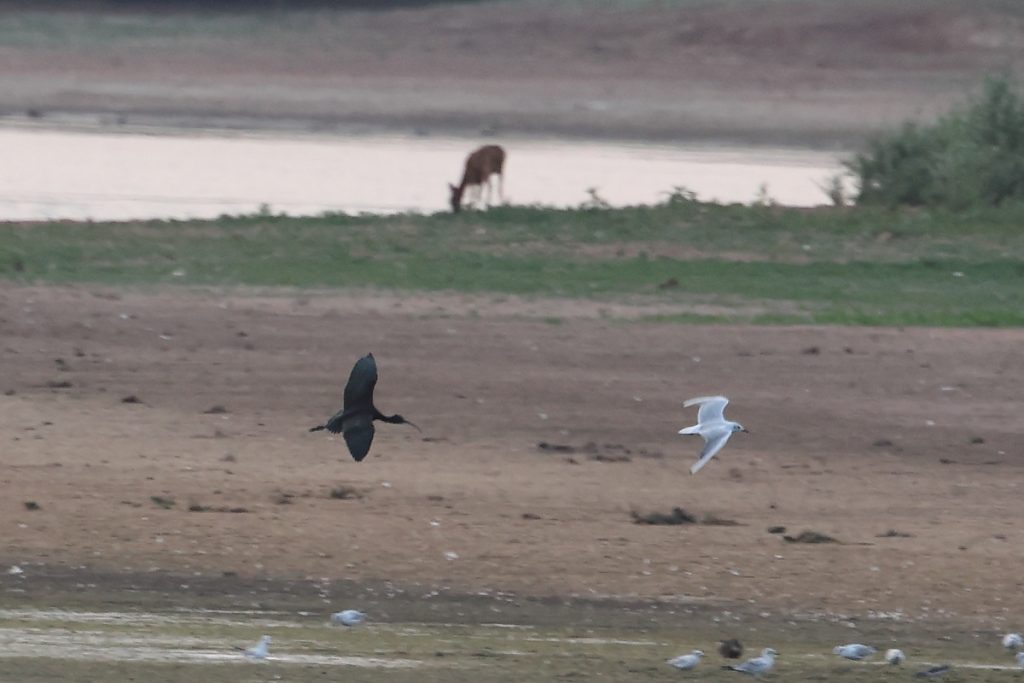
Glossy Ibis, Blagdon Lake © Nigel Milbourne 2025
A record shot taken at 1955 hrs. Did anyone else photograph this bird at Blagdon?
Friday 15th August [Hot & sunny]
I made two trips down the hill hoping against hope something may have dropped in, and I wasn’t disappointed. At Top End, I found the lake’s third GLOSSY IBIS, the first since 2018. Close by were three Lapwings and two Greenshank. At the dam end I saw seven Egyptian Geese, and in the evening, four Common Sandpipers at Cheddar Water/Pipe Bay. The Great White Egret count was down to 26, but the Little Egret count was up to 15 and four Cattle Egrets added to the spectacle. At dusk the egrets gathered as usual at Top End with many of the ducks and Coots. When they flew up to roost I saw the Ibis go up with them but I didn’t see it go into the trees as I lost sight of it in the throng of gulls and egrets all in the air at the same time. Pete and Charlotte reported seeing a Grey Partridge cross the road at Flower Corner; doubtless another of the released birds wandering down from the hill. 39 spp.
Thursday 14th August [Brightening as the day wore on]
I was quite interested to see how many Great White Egrets came back today, so went for a look late morning. I eventually counted 43 scattered around the lake, as well as four Little Egrets. At Top End the group of Little Grebes numbered 25, but I couldn’t find any waders. 24 spp.
Wednesday 13th August [Warm & overcast]
There was an extraordinary sight of 45 Great White Egrets (I put news out of 43 before seeing two more) at Top End this evening, watched by Martin K. and I. After an abortive attempt to roost in the pines along Indian Country bank, a sizeable part of the flock flew off to t’other place, and we watched 25 (the same as last night) fly up into the pines after the others had gone. I also counted six Little and two Cattle Egrets in the throng. A Common Sandpiper was feeding at Cheddar Water, and there were 11 Egyptian Geese at the dam end, 22 Little Grebes, 17 Great Crested Grebes and 29 Teal. 35 spp.
Tuesday 12th August [Very hot]
I walked with friends in the morning, then met Mark H and Ken A. to do a short bat trapping session in the evening. Before getting the bat traps out, I had a quick look around and saw three Greenshank and counted 25 Great White Egrets at Top End. There were Little and Cattle Egrets too, but I didn’t have time to count them. Chris P. emailed to say he’d seen four Common Sandpipers at Cheddar Water – thanks Chris.
We ran three harp traps with lures at Top End and caught:
-
- Soprano Pipistrelle – five, two males & three females.
- Whiskered – one male
- Brandt’s – one male
Monday 11th August [A sunny start, gradually clouding over. Dry & warm.]
Rob H. and I did the WeBS count this morning from 0915-1230 hrs. Water level < 50%. There was an Osprey present throughout, and still present when I left at 1330 hrs. Count details were as follows (with a note that the accuracy wasn’t as good as it might have been, due to the heat haze and distance from the birds): Canada Goose 237, Greylag Goose 18, Mute Swan 35 (inc. 3 juvs.), Egyptian Goose 9, Shoveler 10, Gadwall 205, Mallard 376, Teal 5, Tufted Duck 98, Moorhen 36, Coot 515, Little Grebe 17, Great Crested Grebe 12, Lapwing 9, Common Sandpiper 2, Black-headed Gull c. 140, Herring Gull 5, Great Black-backed Gull 18, Lesser Black-backed Gull 36, Cormorant 9, Little Egret 3, Great White Egret 19, Cattle Egret 2, Grey Heron 18, Osprey 1, Buzzard 5, Hobby 2, and Grey Wagtail 7. 40 spp.
I went back to the lake this evening hoping something might have turned up at the lake, as there seemed to have been something of a fall at t’other place this afternoon. Sadly, there was now’t new, although I spent a very pleasant hour or two chatting with Chris P. on Rainbow Point. We saw a Hobby briefly, and 20 Great White Egrets go to roost in the Indian Country pines.
Sunday 10th August [Mainly sunny]
I enjoyed a late afternoon walk from Home to Top End gate and back. I saw three Common Sandpipers, one Green Sandpiper, five Little Egrets, 19 Great White Egrets, one Cattle Egret, five Grey Herons, an Osprey, two Buzzards, a Hobby, a Spotted Flycatcher, and a Holly Blue, of note. 50 spp.
Tina B. rang this evening, and brought me a ring she’d removed from a bat she’d found dead on a track in Ubley. As it turns out, the ring J13570, was put on a male Nathusius’ Pipistrelle by Mark H., caught at Top End on 25th May 2019, which means it had died, at the most, two fields away from where it was ringed six years earlier. It seems unlikely to me, that this was a bat that was migrating to and from Europe in the interim period. Thanks to Tina for having the presence of mind to collect and re-unite us with the ring, even though it sounds like the bat probably met a sad, and untimely, end.
Saturday 9th August [A pleasant sunny day, but breezy.]
I went to the lake fairly early this morning from 0845-1000 hrs in order to put some food in the bird feeder because I didn’t get to it yesterday. BOC had a walk shortly afterward and seemed to have seen a reasonable selection of birds, including Peregrine, Meadow Pipit, Spotted Flycatcher and Greenfinch. I saw a Wigeon at Top End, 19 Little Grebes, 15 Great White Egrets and a Cattle Egret of particular note in my short visit, and Merv P. told me he saw two Lapwings between 1000-1300 hrs, plus 18 Great White and three Little Egrets. 35 spp.
Friday 8th August [Warm sunshine broke through morning cloud around lunchtime]
I thought I was going to spend part of my day by the lake today, but fate decided otherwise. I had a call from Jim C. at the airport to say a bat had been found roosting out in the open airside. All the arrangements were duly made and I was escorted through security to the bat. It turned out to be a female Whiskered, that I decided to take into care. As it turned out, she appeared to be in good health and ate a few mealworms before having a prolonged flight around the kitchen, so I decided to take her back up the hill at dusk and released her, hoping she’ll find somewhere safer, and more discrete, to roost by morning.
Thursday 7th August [A grey day with showers]
There were eight Egyptian Geese at the lake according to a report on Avon Birds today.
Wednesday 6th August
Today I was in Cornwall, walking one of the last five sections of the South West Coast Path that I was unable to do in 2013-14. I walked from Mevagissey to Portloe (13.9 miles), climbing 3000 feet in the process. It was quite a day in many ways, but for me, the most uplifting memory of the walk, was the clouds of butterflies lifting off flowers all along the way. Mind you, the wall-to-wall sunshine, light breeze, and stunning views will also live long in the memory – I hope!
Monday 4th August [Wet until tea time]
This morning I met Chris Sperring, Melanie and Lionel, when Chris ringed an owlet. He told us that Barn and Tawny Owls have had a terrible breeding season, and the owlet he ringed was one of very few this year in the south west. On the way back, I spent half an hour looking over Top End. All the Garganey, it seems, have moved on. There was nowt much else to report apart from 15 Little Grebes, 17 Little Egrets, 15 Great White Egrets and five Grey Herons. 29 spp.
Sunday 3rd August [Rain showers swept in late morning]
I met Mark H. and Ken A. for a ‘big breakfast’ at Farrington’s this morning, before heading off to a local woodland to collect some bat detectors we’d put up a week ago, just before the rain came in. In the evening I spent an hour at the lake, having read reports of three Garganey at Top End per Andy M., and an Osprey per Birdguides. I didn’t see much at all at Top End, the Garganey had gone, and there was no sign of an Osprey anywhere. The only small duck were two Teal. There was a distant Lapwing on the North Shore and a Common Sandpiper at the dam though. Egret counts were four Little, 12 Great White and eight Grey Herons. 38 spp.
Saturday 2nd August [Warm & pleasant]
I did a Parkrun in the morning at Radstock Five Arches, along the old railway track. As I was warming down, along the course on the Welton side of the Five Arches bridge (Welton Hollow on the OS map), I heard a Crossbill calling from the top of a conifer but I couldn’t see it with the naked eye. A few moments later a Red Kite showed over adjacent fields a couple of times.
I went to the lake between 2000-2100 hrs and spent most of the time scanning the Top End as the sun went down. There were a number of waterfowl species, including a few Shoveler new in, 16 Little Grebes, a few Teal and a Garganey. Then I counted the egrets; 12 Great White, five Little and three Cattle, as they started to assemble to roost. I noted a Kestrel and Buzzard on the exposed lake bed, and a Hobby catching insects over open water towards Rainbow Point. I had seen a Common Sandpiper at the dam, but couldn’t see any around Top End. As I was about to leave, I went through the wildfowl again and couldn’t find the Garganey where I’d seen it earlier. So, I searched the further tract of open water again without luck, and eventually found it in the nearest patch of open water to the hide. I followed it as it swam towards me until it joined two other small ducks which I also think were Garganey, but by then the light was beginning to go. None of the three had the typical pale markings of a Teal by the tail though. 32 spp.
Friday 1st August [Sunny spells & breezy]
I went to the lake early afternoon to look for spots where we might put up bat traps in the evening along Butcombe Bank around the Fishing Lodge. In the evening we split into two groups, one with Jim M. at the Lodge, and ourselves at Butcombe Bay. We caught ten Soprano Pipistrelles, three Lesser Horseshoes and a Daubenton’s Bat. The other group caught a single Nathusius’ Pipistrelle, some Soprano’s and at least one Lesser Horseshoe too as far as I know. So, for the second session this year, it was quite disappointing. There were a few egrets around Butcombe Bay, and when it got dark we used thermal and infra-red imaging kit to see lots of bats feeding out over the open water (Daubenton’s mainly I expect), but they weren’t coming into the traps.