
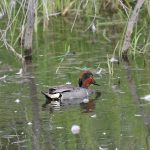
Teal Anas crecca Linnaeus, 1758
Chew Valley Lake, B&NES © Nigel Milbourne 2006
Teal Anas crecca crecca Linnaeus, C., 1758.
Common, passage migrant & winter visitor. Formerly bred. May be seen in most months of the year.
Stanley Lewis records that “the nest has been noted on several occasions at Blagdon reservoir, where the teal is a fairly regular breeder…”
Click on an image to enlarge it.
Note navigation arrows either side of, & slideshow option top right of, enlarged images.


Green-winged Teal Anas crecca carolinensis Gmelin, JF., 1789.
Very rare, Nearctic vagrant. November to January.
- One male, adult, 18th Dec. 1949 (B.J. King & D. Taylor).
- One male, adult, 6th Jan. 1994 (M.G. Prince).
- One male, not aged, 27th Dec. 2002 (Dr. P. Burrows ).
- One male, adult, 9th Nov. 2014 (N.R. Milbourne).
- One male, adult, 6th-7th Dec. 2021 (N.R. Milbourne, M. Hynam).
Since 1999, the Taxonomic Advisory Committee of the Association of European Records Committees and Taxonomic Sub-Committee of the British Ornithologist’s Union Records Committee have been working closely together to produce advice on avian taxonomy in Europe. The BOURC, following recommendations from the taxonomic committees, perhaps controversially, split the Common Teal into the Eurasian Teal Anas crecca and Green-winged Teal Anas carolinensis. However, Jon L. Dunn, noted American ornithologist, told me that he thought the taxonomic split was a little suspect and he intimated that the decision ought, perhaps, to be reviewed. At the time of writing, however, I shall follow the BOURC line in considering Green-winged Teal to be a full species.
Bernard King and D. Taylor found an adult drake among Eurasian Teal on 18th December 1949. The bird was viewed with a telescope at fifty yards’ range. The following characters were noted – white, vertical breast-band immediately fore of the wing; absence of white horizontal band above wing; ill-defined and scarcely perceptible creamy-white line separating chestnut crown from green eye-band; warmer ground-colour of lower breast. Sir Peter Scott reported that all captive Green-winged Teal in the British Isles were permanently pinioned at the time, so the bird was considered to be a genuinely wild visitor, making this the first record for the district and for the then County of Somerset.
At Chew Valley Lake, a drake returned for it’s sixth consecutive winter from 3rd October 1993 until 22nd January 1994, however, on the 6th January 1994 it was seen at Blagdon Lake by M.G. Prince; thus becoming the second site record. On 27th December 2002 Dr. Paul Burrows reported a drake briefly at Top End, but despite extensive searching during the remainder of the afternoon and next day it was not seen again.
Being a dabbling duck, it will usually be found in shallow margins, especially where there is emergent vegetation e.g. Top End and Rugmoor Bay, during Autumn and Winter.
Bibliography (sources of information):
- British Trust for Ornithology (BTO) website
- Blaythwayt, Rev F.L. (ed.). Report on Somerset Birds, 1949. Somersetshire Archaeol. & Nat. Hist. Soc.
- Davis, H.H. (ed.). Ornithological Notes Bristol District, 1949. Bristol Naturalists’ Society.
- Lewis, S. 1955. The Breeding Birds of Somerset and their Eggs. Arthur H. Stockwell Ltd., Ilfracombe, Devon.
- Davis, A.H. Avon Bird Report, 1992. Avon Ornithological Group.
- Davis, A.H. (ed.). Avon Bird Report, 2002. Avon Ornithological Group.
Last update: 14th January 2026