Friday 31st January
My apologies for late news received from John S. today, to say that the drake Ring-necked Duck was in Long Bay again yesterday (30th). Thanks John.
Thursday 30th January
I spent much of the day at Musselburgh Lagoons with my sisters. We saw an amazing flock of 44 Goldeneye in the last pool of the River Esk, and a good selection of birds roosting on the new lagoons by the river at high tide, including at least 15 Ringed Plovers and a number of Bar-tailed Godwits. An earlier check of the central lagoons saw them still frozen with very few birds present, although small flocks of Curlew started to arrive there at dusk. We saw a drake Velvet Scoter and a Great Crested Grebe off the sea wall, but there were very few birds close in as the tide started to ebb.
Wednesday 29th January
There was no news from Blagdon today. I spent late afternoon just after high tide at Port Seton where I saw Eider Duck, Redshank, Oystercatcher and Turnstone. Then I moved on to Bents #3 at Ferny Ness, where I saw a Velvet Scoter, a pair of Common Scoter and Kittiwake of note.
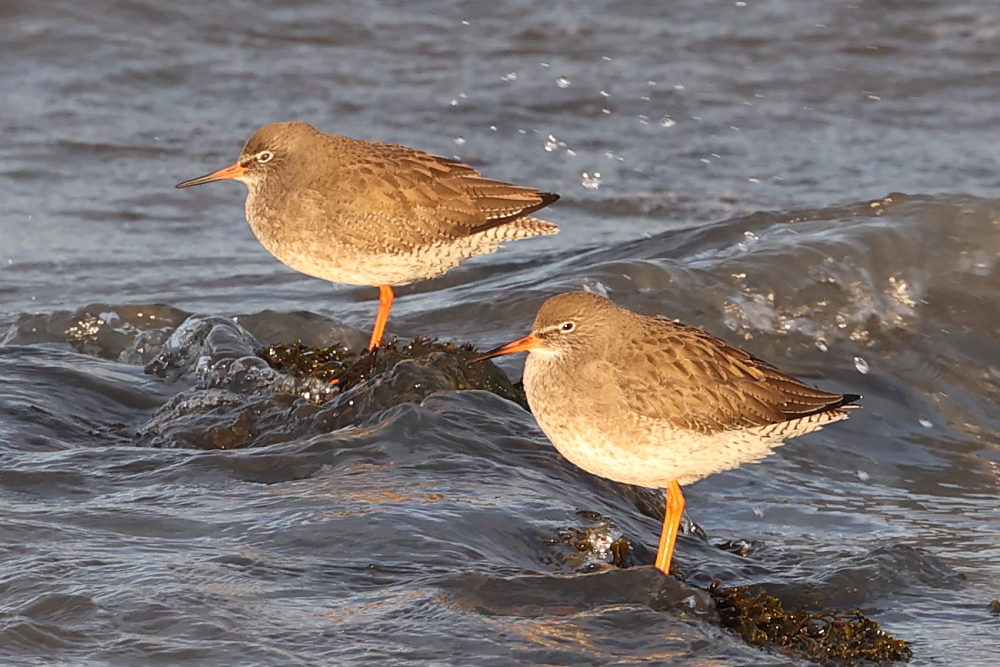
Redshank in late afternoon sunshine, Port Seton, Firth of Forth © Nigel Milbourne 2025


Common Eider male & female, Port Seton, Firth of Forth © Nigel Milbourne 2025
Tuesday 28th January
There was no news from Blagdon Lake today. After a couple of walks and a gym session with my sister, we went down to Aberlady Bay just after high tide but it was too dull for photography. We saw a selection of waders and waterbirds, including Shelduck and Dunlin, then we moved on to Ferny Ness,Bents #3 where we saw Common Scoter, Long-tailed Duck and a Slavonian Grebe, of note.
Sunday 26th January
There was a report on Birdguides today that the drake Ring-necked Duck was still at the lake. I spent part of the day at Musselburgh Lagoons on the Firth of Forth, having a look around for the first time since I went there with Jack W. and Sid M. on a day twitch for the Western Sandpiper at Aberlady Bay many moons ago (1997). At high tide some of the marine ducks come close under the sea wall giving a patient photographer the chance to get some images, there are more pictures added to the gallery on the R-b Merganser species page, accessed by clicking the link on the Birds page too:

Drake Long-tailed Duck, Musselburgh, Firth of Forth © Nigel Milbourne 2025

Drake Red-breasted Merganser displaying, Musselburgh, Firth of Forth © Nigel Milbourne 2025

Drake Red-breasted Merganser, Musselburgh, Firth of Forth © Nigel Milbourne 2025
Saturday 25th January
Nick P. sent me a message saying the Ring-necked Duck and Common Sandpiper were still at the lake today, and I had a message from Nick W-B who saw approx. 40 Lapwings too. Thanks guys. I spent part of the afternoon scouting places to photograph some waders and Wigeon at Port Seton including this Curlew:

Juvenile/1st-winter Curlew, Port Seton, Firth of Forth © Nigel Milbourne 2025
Thursday 23rd January
I drove to Scotland yesterday to stay with my sister in East Lothian, and this morning my other sister came over, and together we walked along the beach from The Bents #2 to Cockenzie and back as the tide dropped. It was so lovely to watch Eiders, Long-tailed Ducks and Common Scoters just off the beach in a near flat calm Firth of Forth. Waders included Redshank, Turnstone, Oystercatcher, Bar-tailed Godwit, and Curlew with Wigeon feeding around the rocky outcrops. Tomorrow we are in an area that is on a Red Alert for high winds of up to and over 100mph, so probably won’t be leaving the house. Hopefully we’ll get out with cameras in the next few days though. I’d like to go to Musselburgh Lagoons and Aberlady Bay, which are just down the road, and visit a little spot I noticed today at Port Seton, where a stream runs over the beach through moss covered rocks, to try and photograph the Wigeon there. Anyway, if anyone has any news from Blagdon Lake they’d like to share please message me using the contact link on the welcome page and I’ll put it on the diary.
Tuesday 21st January [Some sunshine & a little milder than of late]
I waited until mid-afternoon to go down to the lake so that I could enjoy a walk to Top End and back after the contractors doing the tree work had finished for the day. The drake Ring-necked Duck was feeding in among some tree roots with a group of Tufted duck close by. I guess they’d been a bit spooked by the tree cutting machinery going past. I reckon there were probably six Great White and one Little Egret dotted around the lake, and the female Greater Scaup was still at Top End. Just three Goosanders, that I could see, showed up before dark at the dam end. 44 spp.
Monday 20th January [Fog to start, clearing late morning. Overcast with some drizzle.]
I had a little time over lunchtime to have a quick look around the dam end in the car. The drake Ring-necked Duck was in Long Bay again, and I saw two Red Kites, four Great White Egrets, and a Common Sandpiper in a reasonable list of 38 spp. in little over an hour.

Red Kite, Blagdon Lake © Nigel Milbourne 2025

Ring-necked Duck, Blagdon Lake © Nigel Milbourne 2025
Sunday 19th January [Overcast and cold. Some drizzle.]
I spent the most lovely day with a group from Bath RSPB group. We met at 0930 for a 1000hrs start on the dam. We walked over the dam hoping to see the Common Sandpiper and both species of wagtail at the Spillway. The sandpiper managed to avoid us though. We parked up at the Fishing Lodge, had a look from the lawn, then set off along the south side of the lake, checking the feeder, and along to Long Bay. More in hope than anything else I stopped the group on the bridge and set up scopes to scan the bay. Blow me, I spotted the drake Ring-necked Duck at the mouth of the bay with a group of several waterfowl. After everyone had got a decent look at it through the scopes we set off along the bay, and were really pleased to see it feeding along the opposite side and showing very nicely between dives. What a lucky find for us. We headed on, steadily accruing a good list of species including a lovely group of Siskins at Hellfire Corner, which we were all able to watch in the scopes. We continued onward taking every opportunity to get great views of the species we saw before moving on. We were running a good bit slower than perhaps the group were expecting, but all enjoying ourselves. At the Top End a Sparrowhawk perched in the top of a tree posing, and the female Scaup gave us great views alongside Gadwall, Teal, Shoveler and Coot. We were also privileged to see up to 20 Snipe too. We made our way smartly back to the Lodge, getting more stunning views of the RND. One or two species only put in brief appearances to a few of the group, but we certainly saw 50 spp. between us. A little later, I popped up to the house for a cuppa and warm up before going back to the dam. I met Marc H. and Jan there and we saw 11 (6 drake) Goosanders arrive before leaving for home. I listed 51 spp. despite missing Dunnock, Magpie, Jay and the sandpiper among others I might have expected to see.
Saturday 18th January [Overcast and cool]
I had a couple of hours at the lake early afternoon, ahead of a visit by a Bath RSPB group tomorrow. I didn’t see anything new that hasn’t been around for a while, but It was nice to meet and have a chat with another a local birder, Max, from Rickford. The adult female Scaup was at Top End, and the usual selection of wintering and resident birds were noted while birding on foot from Rainbow Point to Top End and back. I logged 43 spp.
Friday 17th January [Sunny spells but remaining cool.]
I spent the afternoon at the lake birding on foot from the Lodge to Top End gate & back, then watching from the dam as dusk fell. ‘Philip’ my friendly Pheasant pal came running up to me as soon as I arrived on site and topped up the bird feeder, bless him. He’s such a character.

‘Philip’ © Nigel Milbourne 2025
Marc H didn’t see the RND yesterday, and I couldn’t find him today either. The adult female Scaup was at Top End, and I also counted 12 Wigeon there, up from the one I spotted during the WeBS count earlier in the week. A small flock of 27 Fieldfares was a welcome sight, as was the Kestrel, which I’ve seen three times this week. Three Great White and one Little Egret were still present too. Holt Copse is looking very different now after all the tree work that Hi-Line have carried out during the week. It was lovely to stop and have a natter each afternoon with the guys when they’d finished for the day. They are very engaged with the conservation work BW has asked them to do, and are looking forward to the planting that will follow. The old Oaks around the woodland edge have been retained, as has some of the understorey, but new Oaks and shrubs will be planted to provide a better woodland structure in years to come. When I got back to the dam, I counted 15 (11 drake) Goosanders, found the Common Sandpiper, then headed off home having logged 47 spp.
Thursday 16th January [Foggy all day, although the sun did get through eventually.]
I didn’t go to the lake today. It was too foggy in the morning, and I had my gym session and went running in the afternoon. Thanks to Marc H. I do have news of the female Scaup at Top End, two Egyptian Geese by the Lodge, and the Common Sandpiper at the dam. Thanks Marc.
Wednesday 15th January [Foggy to start then brightening to a lovely afternoon.]
With the work going on at Holt Copse this week and no through route along the south side road, I elected to park at Lodge Copse and walk along to Wood Bay and back with my camera, birding as I went. Bless my soul, but what should I see but the drake Ring-necked Duck back in Long Bay! I wonder where he’s been? I noted three Great White Egrets before turning around and making my way back to the Lodge. I walked across the dam and back and watched a real drama unfold:


Try as it might, the immature Cormorant could not swallow the Tench and after quite some time it gave up, but sadly I don’t think the Tench is likely to survive the mauling it got. This is one of the issues that anglers have with Cormorants on inland waters. Many fish get damaged, even if they’re not eaten. However, the UK population of the Atlantic Cormorant is a significant proportion of the speciespopulation as a whole. Licences have been granted by the government to control the population in order to reduce the conflict between fishery interests and the birds, and a lot of scientific research has been going on since the turn of the century to make sure that robust data provide licence quotas that also ensure that the species isn’t driven to the point of extinction. The UK breeding population (1998-2002) was estimated at just 8900 pairs (BTO). After a quick cuppa at home, I went back to the lake and saw the Common Sandpiper at the dam late afternoon, and I waited until dusk to watch the Goosanders arrive and display. There were 22 birds, but they stayed way over towards Spinney Copse this evening and way out of camera range. However, I did see one bird flying in from the west and got a couple of shots of it from the dam as it circled round to land at 1621 hrs. I pushed the ISO up to 2000, with a shutter speed of 1/2000 sec. at an aperture of 6.3 to get this image, which although not perfect, far exceeds anything I might have been able to obtain in the past, just 11 mins before sunset (although the sun had gone down long before that in Blagdon, with the Mendip Hills in the way). I’ll have to wait for another day to try and photograph the Goosanders displaying. My day list was 44 spp. even though I didn’t go to Top End at all.

Adult female Goosander, Blagdon Lake © Nigel Milbourne 2025
Tuesday 14th January [A milder, still, day. Overcast with mist in the afternoon.]
I left it until the afternoon to visit the lake, checking out the dam, and Lodge to Rainbow Point before 1500 hrs then, when the tree work had finished for the day at Holt Copse, I birded on foot to Top End gate and back to Rainbow Point. I got a real surprise when I got the through the Lodge gate, there were two Red-legged Partridges just the other side of the hedge on Holt Farm. The female Scaup was still at Top End, and I saw four Great White Egrets in the gloom. I arrived back at the dam on the way home to look through the gathering flocks of wildfowl, and saw 15 (nine adult and one 1st-winter male) Goosanders, and counted 36 Goldeneye in the throng. It was quite a sight with both the Goldeneye and Goosanders displaying for all they were worth. Just before I left, I heard a Tawny Owl calling at the south end of the dam. 46 spp.
Monday 13th January [A cold a stiff breeze this morning, calming down later.]
Phil, Rob, Skip and I did the WeBS count this morning 0940-1402hrs. The lake was full. There was no sign of the Ring-necked Duck, so we can reasonably assume it has moved on. The adult female Scaup was still at Top End. The count was as follows: Canada Goose 65, Mute Swan 10 (inc. 1 juv.), Shoveler 19, Gadwall 47, Wigeon 2, Mallard 41, Teal 72, Pochard 76, Tufted Duck 860, Scaup 1 ad. female, Goldeneye 26, Goosander 2 adult drakes, Moorhen 13, Coot 1223, Little Grebe 9, Great Crested Grebe 24, Lapwing 41+, Snipe 8, Common Sandpiper 1, Great Black-backed Gull 2, Lesser Black-backed Gull 1, Herring Gull 4, Cormorant 52, Little Egret 1, Great White Egret 5, Grey Heron 5, Buzzard 2, Kestrel 1, Grey Wagtail 1. 47 spp. No apologies for another picture of the Common Sandpiper which seems to be enjoying feeding in the Spillway at the moment, with just a dribble of water going down it:

Common Sandpiper, Spillway © Nigel Milbourne 2025
Sunday 12th January [Milder today. Overcast to start, then turning into a sunny afternoon.]
I went to the lake with my camera hoping to get some waterbird pictures for the species galleries. I met Andy M. when I got to the Lodge, but he had bad news – no sign of the Ring-necked Duck or Scaup. I topped up the feeder then drove slowly along the south side road birding as I went. I saw one or three flock(s) of Lapwings over the lake during my time there, the biggest of which had at least 100 birds in it. I found the female Scaup at Top End, but there was no sign of the RND. I got back to the Lodge when Marc H. and Jan showed up. I saw my second Red Kite before we decided to go for a walk over the dam with our cameras, because Marc wanted to see the Common Sandpiper. True to form it was feeding along the south end of the wall and showed very nicely. Along the dam we came across a pair of Goldeneye and a Great Crested Grebe which I photographed for my species galleries. When we got back to the Lodge I had another quick look for the RND, but there was still no sign, so I left Marc and Jan to it, and went home in order to get out for a run before it got too dark. Additional sightings included 85 Canada Geese, three Great White Egrets, a Little Egret in breeding plumage, and two Red Kites in a day list of 46 spp. It’s WeBS count day again tomorrow. Day list 47 spp.

Probable adult, Great Crested Grebe in winter plumage, Blagdon Lake @ Nigel Milbourne 2025
Saturday 11th January [Cold, sunny then clouding over.]
What a joy to go for a good long walk without the piercing wind we’ve had of late. I walked from home to Top End gate and back, including a walk across the dam and back hoping to catch up with the wagtail spp. and Common Sandpiper. Sadly, none of them put in an appearance. Nertheless, I saw the drake Ring-necked Duck in Long Bay, and the female Scaup at Top End. There were three or four Great White Egrets and three Little Egrets, a flock of 26 Lapwings, a Chiffchaff, a Blackcap feeding on the mistletoe berries in the poplar trees at the entrance to the Hatchery, and eight Goosanders in Butcombe Bay mid-afternoon. When I totted everything up, before sticking my list on BirdTrack, I’d logged 56 spp.
Friday 10th January [Cold, overcast with some sun]
I spent a bit of time at the lake again today, saw the adult drake Ring-necked Duck and adult female Scaup both on the lake, and had a walk at Top End where I steadily built a decent day list, without seeing anything exceptional before heading back to the dam. I wanted to have another go at photographing the Cormorants in Long Bay. No such luck, there was a guy in a large tractor still cutting the hedge where I’d left him more than two hours before! As I set out across the dam a flock of about 100 Lapwings flew over heading west, and I’d seen three Great White and one Little Egret in a total of 49 spp. I found the Common Sandpiper in the Spillway sometime after 1600 hrs. It gave me the chance to take some shots in low light with the new camera. I pushed the ISO up to 1600 as a trial, with surprisingly acceptable results:

Common Sandpiper, Spillway © Nigel Milbourne 2025

Adult drake Goosander, dam © Nigel Milbourne 2025

Adult female Goosander, dam © Nigel Milbourne 2025
Wednesday 8th January [Overcast, snow started late afternoon.]
I got well togged up today, in order to go and refill the bird feeder. Then, I drove to Rainbow Point and birded on foot to Top End gate and back. The drake Ring-necked Duck and adult female Scaup were both still in residence, as were three Great White Egrets. I finally caught up with Fieldfare today, at Top End, and saw a couple of Treecreepers along the way, as well as a couple of Siskins and a Chiffchaff. 49 spp. – not bad for two hours.
Tuesday 7th January [Early snow, melted quickly, but the cold wind persisted.]
I had an enjoyable afternoon roaming back and forth along the south side of the lake witeh my nw camera, but although it’s an updated version of my dear old Canon 1DMk2n and 1DMk3, it’s hugely more spohisticated and, to be fair, I didn’t do quite as well as I’d hoped, compared to my old faithfuls. I saw the drake Ring-necked Duck in Long Bay, but while watching it and the Pochard, all the waterfowl suddenly alarmed and rushed to the bridge end of the bay in front of me as if being chased by something. I wondered whether an Otter might be responsible but couldn’t see it. However, there was also a terrific barrage of loud gunfire coming from the Wills estate (its been going on for days), so I don’t know what caused the panic. Pete and Charlotte came along and said the gunfire had cleared the feeder while they were watching it, so perhaps that was what was responsible. Anyway, whatever it was resulted in all the ducks flying off, including the RND. I saw a couple of Siskins in Lodge Copse, and the female Scaup along Burmah Road, really close to the bank where it has been feeding on and off for a while. Three Great White Egrets were roving around, and the Common Sandpiper showed within a few feet on the dam wall, while I was chatting to Mark before I went up the hill, chilled to the bone. I’d pointed the camera at a Cormorant (probably the same one shown on the 5th Jan.), and the Common Sandpiper in the fading light. I should have had some amazing frame-filling pictures of the Sandpiper, but instead of raising the ISO value up from 400, which I rarely did on the old cameras, I used too slow a shutter speed. Doh! Back to the 900 page manual and more practice is required. I met Marc H. and Chris G. before leaving the lake, and just after we parted ways, Chris reported seeing an Otter from Rainbow Point. 43 spp.
Monday 6th January [Sunny with a cold wind this morning.]
I didn’t visit the lake today, preferring to do some work on the website, before I went to pick up with my exercise regime this afternoon. However, I understand the Ring-necked Duck was still present, and Siskins were visiting the feeder; which reminds me, I’ve got to refill it tomorrow morning. Although my run didn’t take me over the dam, I’m pretty sure last night’s rain will have seen the water, finally, flowing down the spillway for the first time this winter. This may be the start of a very long and hazardous journey for some of the Eels in the lake, as they set out down the Yeo and out to sea, heading back to their birthplace in the Sargasso Sea to spawn. In the past, I’ve stood on the bridge at the end of the dam in the dark with a torch, and seen eels go over the rim of the overspill and swim off down spillway at the start of that journey. Although the lake has had eels introduced into it, as part of a supplementary conservation programme, in a bid to help try and turn around the catastrophic decline in numbers reaching the European seaboard, I’m not so sure this would be a worthwhile exercise today – but, you don’t know unless you look do you? Maybe, when it’s a bit warmer, eh?
See government press release (2022): Ancient mystery of European eel migration unravelled to help combat decline of critically endangered species.
Sunday 5th January [Mild & overcast, after overnight snow.]
Andy M. visited the lake an hour or two before me this morning, and I was really pleased to read that he’d seen the putative Lesser Scaup-like Aythya hybrid that’s been causing all the fun and games from the Lodge, the drake Ringed Duck, and the female Greater Scaup. I got there late lunchtime and once again, the RND eluded my gaze for ages before I finally caught up with it. I was sitting in the car, using it as my hide, hoping to capture some trial images of the birds in the bay using my new camera body on a 300mm lens with a 1.4x converter. Frankie came along, having dipped the RND yesterday, just as it put in an appearance. We watched the birds in the bay while I took a few trial shots before going to the dam to look for the putative Lesser Scaup-like hybrid. We didn’t see it, although I suspect that was due to one of the BW rangers going out in the rib. Loads of Aythya ducks had flown past me at Green Lawn heading up towards Top End, and although I didn’t see it in the groups flying by, I suppose it must have gone with them. I recorded everything I saw, but wasn’t really trying to amass a day list this afternoon. Nevertheless, I saw three, possibly four, Great White Egrets in a total of 36 spp.

Great Cormorant, Long Bay © Nigel Milbourne 2025
I’ve been trying to get a few pictures to add to my photo gallery on the Great Cormorant page, especially to illustrate the differences between the two ssp. carbo and sinensis. I’ve told a few birdwatchers that, many years ago, Graham Ekins wrote back to my enquiry about ssp. differences, that one thing to look for is adult birds that appear to have white thigh patches before the year end. These are very likely to be sinensis, the colonising, tree nesting, Continental Cormorant. I have been attempting to put this to the test as I build up a catalogue of pictures taken at the lake. There have been papers and articles that say the definitve difference between the two ssp. is the angle of the back edge of the yellow/orange gular patch when seen against the white face patch. An acute angle is characteristic of carbo, the Atlantic Cormorant that used to breed solely along the coast, while an obtuse angle is characteristic of sinensis. Okay, so what would you say the bird I took a picture of today is? Before I tell you what I think, I need to mention the excellent, illustrated, article that was written by Keith Vinicombe a few years ago that I have put a link to at the bottom of the Great Cormorant page – it is a real help to understanding, and well worth a read if you want to improve your birding. However, the one thing you need to do, is view the head from side on, in order to reach an informed opinion about the angle of the gular patch. Right then, the bird above – it appeared to be an adult and there are no breeding patches on the thighs, so I’m immediatley thinking carbo, but I didn’t quite nail the head from side on, so we need to bear that in mind. Nevertheless, the gular patch angle looks like it might be an acute angle, also indicative of carbo. Earlier I said carbo used to breed solely along the coast, but in recent years they have taken to breeding on inland waters alongside and, in some cases with sinensis thereby producing hybrids. I think this particular bird is one of those that I wouldn’t like to call for that reason, and because the head isn’t shown exactly side on. In all probability it is a carbo, but sometimes we have to understand that we can’t always put a name to a bird, and accept it – there’s no shame in that. There are some more photos on the Great Cormorant page which have been more easily assigned to ssp., if you want to take look. Better still, get out in the field and take a closer look at some of those Cormorants yourself, you never know, you might spot a Shag, a real rarity at the reservoirs, or better still, the second British record of a Double-crested Cormorant! There’s one in Ireland….
Saturday 4th January [Cold & overcast]
Finally, I took the opportunity to bird at the lake without worrying about a hybrid Aythya duck! I walked from the house and birded my way to Top End and back to the dam, then across the dam and back up the hill (6.9 miles). I saw a reasonable variety of birds, including three Great White Egrets, three Snipe, a female Scaup, c. 90 Canada Geese, an adult drake Goosander, a Common Sandpiper, and a Chiffchaff. Sadly, it looks like the Ring-necked Duck has got fed up with all the attention. I didn’t see it yesterday afternoon or today. I looked in some of the spots it has moved to in previous winters, but there was no sign. Fingers crossed it hasn’t decided to go elsewhere. Since the cold weather snap, I’ve only seen a handful of Redwings and not a single Fieldfare (which usually come to the lakeside to roost on winter evenings). 48 spp.
Friday 3rd January [Cold, clear & bright.]
It was another beautiful day, so it was down to the lake. Once again, I got distracted by the ‘Lesser Scaup’ that isn’t. I managed to get some pictures, albeit rather distant ones:

This photo shows the bird is similar in size to Tufteds, but look at the flank pattern & head/bill shape compared with the Lesser Scaup pictures taken on the 20th Dec. 2024. These were among the factors that made me doubt my initial assertion that this was the Lesser Scaup, relocating by the 22nd Dec. & showing most of the time feeding and facing into the wind when viewed from the dam. I’m not the first, & won’t be the last, tripped up by these hybrids.

The head of this bird looks rounded with a thick neck. Compare this with the photo of the Lesser Scaup taken on the 6th December 2024. In addition, on that bird, the underwing appears to show grey greater underwing coverts compared with the Scaup-like, wholly white underwing of the bird above.

The upperwing shows a white secondary panel, bleeding into the primaries similar to a Greater Scaup. Compare with the photo taken on 20th December.
Is it, therefore, a Greater Scaup? Personally, I think it’s probably a hybrid, maybe a Tufted Duck x Greater Scaup, but not a pure Lesser Scaup for sure. After my time with the camera, I drove to Green Lawn, didn’t see the Ring-necked Duck reportedly present today, and birded to Top End gate and back. Then, I had a look over the dam when I headed home. Of note, I saw a Common Sandpiper, two Great White Egrets, two Little Egrets, two Mistle Thrushes, heard a Water Rail and Chifchaff, and counted 12 (three adult drake) Goosanders at dusk. Ice has been starting to form in the sheltered margins. 48 spp.
Thursday 2nd January [Cold, clear & bright.]
I went out the back door at 0750 hrs, but it took me 20 mins. to get into my car and get it roadworthy, so the sun was just beginning to throw some light on the lake when I arrived at the dam. I saw the ‘Lesser Scaup’ more or less straight away. Then I headed to the Lodge, but it took me another 15 mins., or so, to unfreeze the lock on the gate to get in! Anyway, I topped up the feeder and pottered around, when Rich M. called me to say he was coming over to look at the LS at my request. We were joined by Chris C. and spent quite a bit of time discussing and watching it. We are all puzzled by the curious head shape and agree that the bill didn’t look quite right, although the isolated black nail was fine. We all think the bird looks slightly bigger and less ‘squat’ than we would expect of a LS too, and when compared with adjacent Tufteds. So, the question is, have we got a different bird since the 20th December, or was the original ID incorrect, or are we over-thinking it? We need to see an upper wing flap to help decide if this is, a different bird to the one that was originally in Holt Bay. For me the jury is still out on the ID of the bird off the dam. Has anyone got a picture of the upper wing taken since the 22nd Dec.?
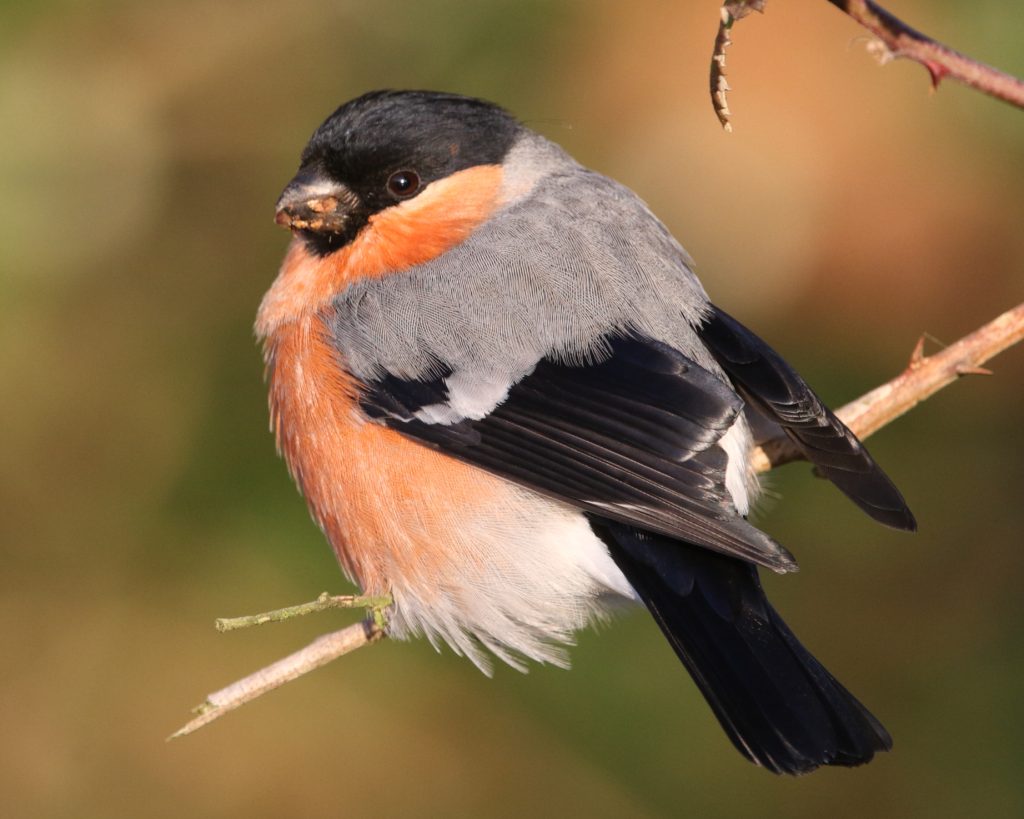
Male Bullfinch, Long Bay Pines, Blagdon Lake © Nigel Milbourne 2025
The drake Ring-necked Duck and female Scaup were both still on the lake, and although my original plan to try and amass a decent first day list of 2025 was scuppered somewhat, I did get to 53 spp. by the time I walked back up the hill. This included three Great White Egrets, a flock of about 50 Lapwings flying west over the dam late afternoon, a Common Sandpiper on the dam wall, and a couple of drake Goosanders at dusk.
Wednesday 1st January [Rain & strong wind overnight continuing well into the day.]
I elected to delay the start of my birding year until tomorrow, given the conditions today. Instead, I more or less completed the Goldeneye species account to something like my satisfaction. I intend to include a couple of graphs to demonstrate winter status at the lake, and will, in time, add to the gallery of photos to illustrate the various plumages of birds occurring at the lake throughout the winter. I would welcome comments. I read that the ‘Lesser Scaup’ and Ring-necked Duck were both present today.