Sunday 31st May [Sunny spells. Breezy.]
I spent an hour and a half at the lake late this afternoon, during which the sun came out and gave me the chance to see some insects. Mark H. had texted me earlier that he’d see a large flock of some 30-40 Cattle Egrets at Rugmoor, and when I was at the lake I saw lots of ones, twos, and small groups plus eighteen or more at Rugmoor. My best single view count was 23, but it was some time after Mark saw them, and they were very mobile. I heard a Cuckoo singing somewhere over on the north side of Top End, and noted 34 bird species in total. I was hoping to spend some time looking at dragonflies (no easy task at Blagdon these days), and saw one each of male Common Darter and Black-tailed Skimmer, but no Emperor spp. I even looked at hundreds of damselflies, but every last one was a Common Blue! I came across the rather nice woodland edge hoverfly Xylota segnis, and saw my first 6-Spot Burnet Moth of the year, as well as more 5-Spot Burnet Moths (which generally emerge earlier in the year). NIck P. reported twelve Cattle and five Little Egrets later still.
Saturday 30th May [A lovely morning for a Parkrun. Cloudy later.]
Melanie P. heard the Cuckoo singing near Top End this evening. Thanks Melanie.
Friday 29th May [Hot & sunny]
Sarah L. contacted me to say she’d heard a Cuckoo singing probably from the north side of the lake today. Thanks Sarah.
Wednesday 27th May [Pretty hot with a stiff breeze]
I took a couple of hours around midday to try and get some pictures of the Five-spot Burnet Moths despite the rather extreme heat. Every burnet moth I looked at today was a Five-spot, whether on the south or north shore. The breeze and heat made photography tricky. I stopped at the corner of Long Bay and Green Lawn and saw a male Lesser Emperor patrolling, as I had yesterday. At Bell’s Bush a Clouded Yellow butterfly flew past me, as did a male Beautiful Demoiselle at Top End. There were hundreds of Painted Lady butterflies on the wing, both at the lake and in the village today, many of them attracted to Valerian, as they have been in our garden for the last few days. I saw two Marsh Fritillary butterflies, but no Narrow-bordered Bee-hawks. Egrets were the only birds of interest i noted, with two Little, and one each of Cattle and Great White. 27 spp. I’m hoping it’s going to be slightly cooler tomorrow when I get back to the lake with my camera.

Five-spot Burnet Moth, Blagdon Lake © Nigel Milbourne 2026

Five-spot Burnet Moth confluent form, Blagdon Lake © Nigel Milbourne 2026
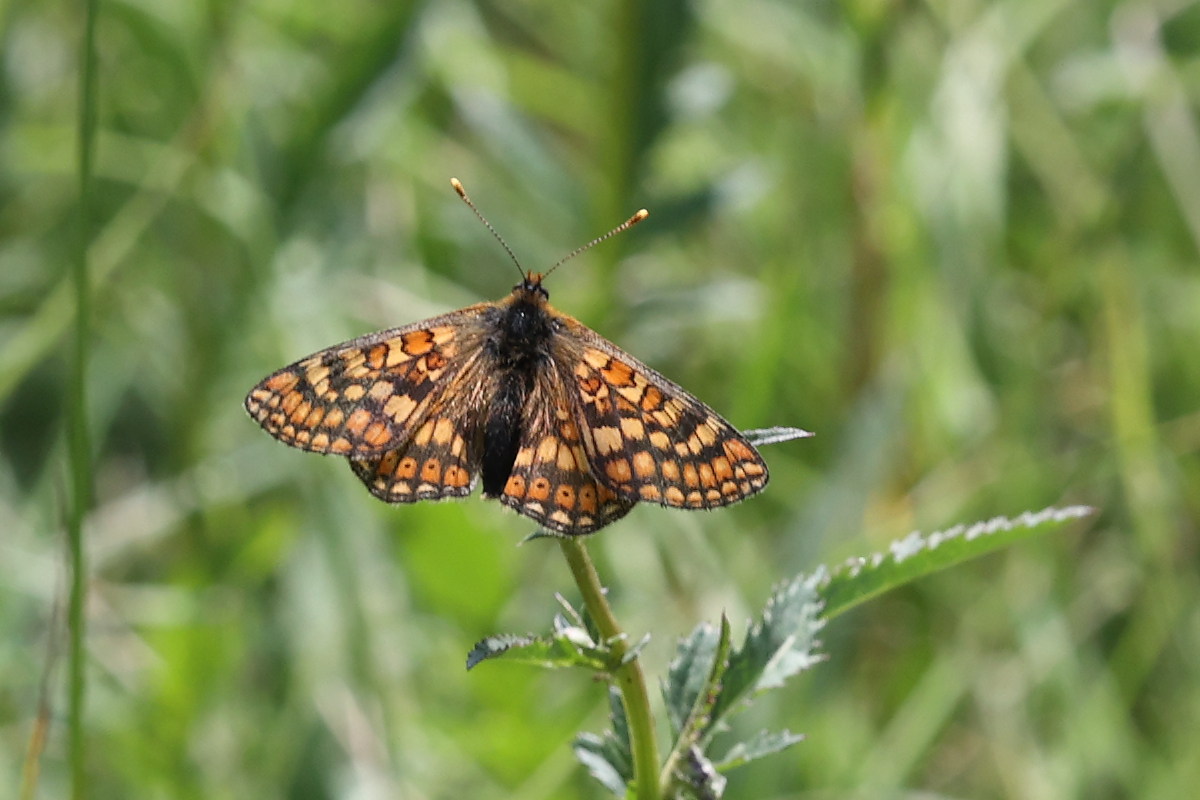
Marsh Fritillary, Blagdon Lake © Nigel Milbourne 2026
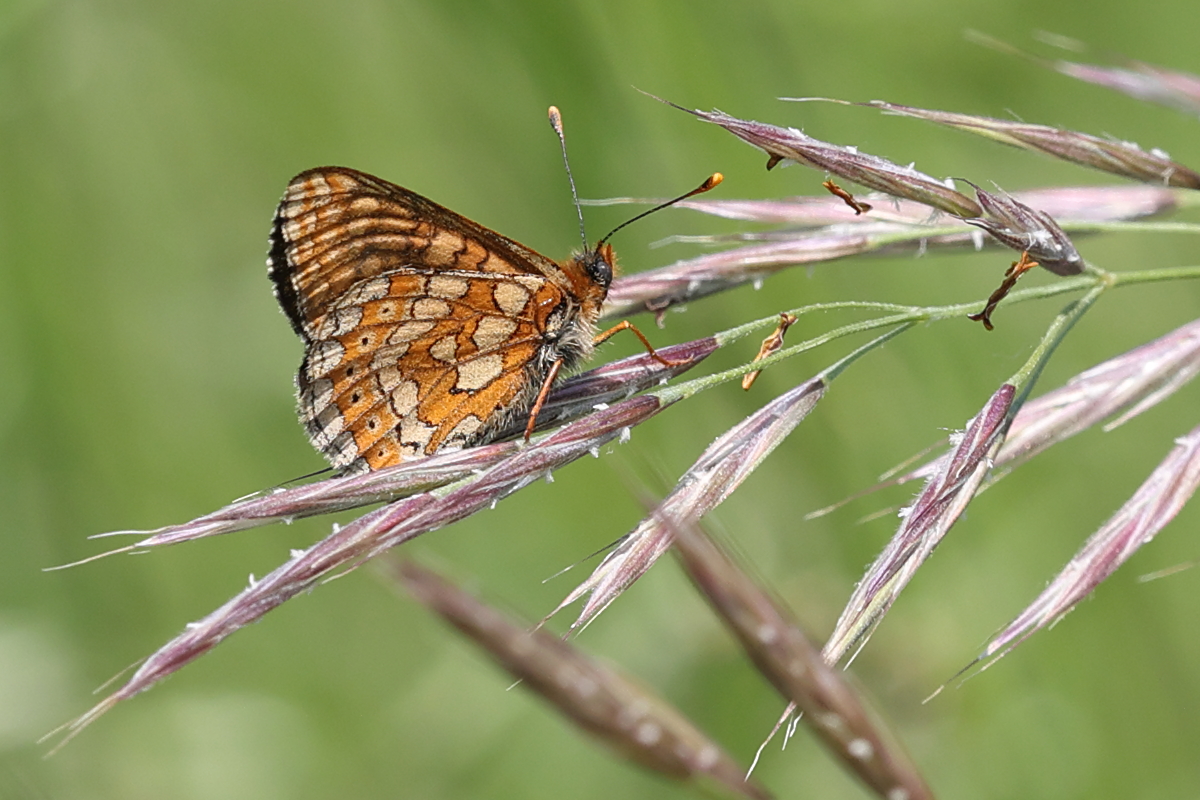
Marsh Fritillary, Blagdon Lake © Nigel Milbourne 2026
Tuesday 26th May [Scorchio]
I believe the highest ever May temperature in the UK was recorded today, and it was the second day locally with temperatures comfortably over 30 Celsius, so not one for me to be out by the lake until things cooled down a bit in the evening. I spent from around 1800-2100 hrs birding from the Lodge to Top End hide and back. When I arrived at the dam, there was a terrific rumbling of thunder in the distance which, happily, seemed to move off towards east Bristol. At the Lodge, I scanned for dragonflies because Andy D. and Rich M. had seen some at Chew today, and amazingly saw one each of male Emperor and Lesser Emperor. As I made my way along the south side, I saw five more male Lesser Emperors, but no more Emperors. I wonder if this is an influx, or a result of local breeding? It was an excellent year for sightings at the lake in 2024 during which I photographed the species ovipositing (see July 2024), and as the nymphal stage takes two years to develop, it is quite likely the adults seen today were locally bred. However, I also counted 14 Painted Lady butterflies, so perhaps the hot weather could have brought an influx of migrant insects north over the last few days too. There wasn’t much to write about the birds I’m afraid. I noted one, but possibly saw three Cattle Egrets, a pair of Canada Geese with three goslings, a female Mallard with six ducklings, some young Pheasants disappearing into the long grass, and heard four singing Cetti’s Warblers. 37 spp. I am hoping to spend time over the next couple of days, if it cools down a bit, photographing some of the invertebrates brought out by the sunshine, and in particular hoping to photograph the confluent form of Five-spot Burnet Moth. So, what should I see this evening during my walk but my first Five-spot at Blagdon! I tried to photograph it with my phone but it just would not focus properly in the long grass, so I’ll be back with my camera…
Sunday 24th May [A misty start, then sun, sun, sun.]
I met Chris P. this morning at 0730 hrs at the Fishing Lodge, and we birded our way to Top End and back over the course of the morning, as the day heated up. There was lots of bird song early on and we got our day list off to a good start. There was a pair of Mute Swans with seven cygnets at the mouth of Long Bay (1st brood of the year), and a brood of about seven Mallards (3rd brood of the year) at Rainbow Point. A Red Kite and several Buzzards took to the air mid-morning, as we slowly accumulated more species, with two Little Egrets, a fly-over Cattle Egret and two non-breeding Great White Egrets also added. Lots of Burnet Moths were flying in the meadows, probably Six-spot, and we added five species of butterfly. I had a look for Red-eyed Damselfly but didn’t definitely see any, although there were many hundreds of teneral and Common Blue Damselflies on the wing. There was a single male Tufted Duck in Holt Bay, and a Greylag and two Greylag x Canada Goose hybrids on Holt Farm. A European Hornet was investigating the holes and cracks in the wooden pilings of Holt Bay too. Five male Cetti’s Warbler’s were noted singing along the south side, with one seen briefly in flight between bushes. All-in-all, an excellent morning spent in good company. 46 spp.
Sunday 17th May [Overcast & breezy with sunny spells this afternoon]
I did the WeBS count this morning and noted the following: Canada Goose 45 (inc. 1 juv), Greylag Goose 1, Mute Swan 13, Egyptian Goose1, Gadwall 2, Mallard 32, Coot 42, Great Crested Grebe 8, Ringed Plover 1, Black-headed Gull 2, Great Black-backed Gull 3, Cormorant 2, Little Egret 2, Great White Egret 2, Cattle Egret 1, Red Kite 1, Buzzard 1, Hobby 3, Grey Wagtail 1. Total of 44 spp. seen/heard.
After the count, I hosted a visit by Bristol & District Moth Group, the purpose of which was mainly to see Narrow-bordered Bee Hawk and we had absolutely stunning views of two, probably three. Also noted were Marsh Fritillary, Small Copper, a White sp., Speckled Wood and a number of other moths and invertebrates. I think Ray will provide us with a list in time.
Saturday 16th May [Warm & dry early in the day, with rain showers setting in during the afternoon.]
I heard my first Cuckoo at the lake this evening, and saw two Egyptian Geese with the Canada Goose flock, two Great White and a single Little Egret. It was pretty quiet, and I only noted 21 bird spp. I will be doing the WeBS count in the morning.
Friday 15th May [Mainly overcast, with a light north-westerly breeze.]
It was for a second walk with members of the Mendip Society that got me down to the lake today, and with the sunshine a little less kind than Tuesday, we struggled a bit to find some of the star insects we saw then. We did see a single Marsh Fritillary, but the Bee Hawks weren’t flying, unfortunately. There were hundreds of teneral damselflies coming up off the grass, and with the odd burst of sun more flew in from the lake, attracting a couple of Hobbies to hunt briefly. A Red Kite showed to a few of the group over Butcombe Bay, and Swifts were the predominant aerial species over the water. Flowers of note included Southern Marsh, Heath Spotted, Common Spotted, Early Purple and Green-winged Orchids, Milkwort, Goatsbeard (aka Salsify), Pignut, Hemlock Water Dropwort, and Saw-wort, Knapweed, Devil’s-bit Scabious, Betony and others that have yet to bloom – they’re a little later than this time last year. Birds, heard/seen, included Reed Bunting, Reed Warbler, Sedge Warbler, Blackcap, Chiffchaff, Garden Warbler, Great Spotted Woodpecker, Buzzard, Kestrel, Grey Heron, Swallow, and House Martin in a list of 36 spp. noted by me.
Tuesday 12th May [Sunny spells but cool & breezy]
I had the pleasure of hosting a group of Mendip Society members at the lake today from 1030-1310 hrs, the main aim of which was to look at the meadows. We took in plenty of the other wildlife on offer too, of course, and thoroughly enjoyed the sunny spells we were afforded. From my point of view, the greatest excitement was in seeing a few Marsh Fritillary butterflies (no fewer than eight) and two of the locally rare Narrow-bordered Bee Hawk moths. We noted a Burnet Companion moth too, but the day-flying Burnet moths we saw at this time last year do not appear to have developed into adults yet. There were hunderds, if not thousands, of teneral damselflies sheltering in the grass, but no Hobbies on the wing, unfortunately. We compared the songs of Reed and Garden Warblers and had a close encounter with a Red Kite that virtually flew overhead. A few Swallows were feeding over the meadows, and we saw a couple of House Martins among them. There were many pairs of Swift, and other small groups chasing each other, as they do, before pairing up and settling to breed. A few Spindle bushes in the boundary hedge had larval webs of the Spindle Ermine moth in them, complete with growing caterpillars that have yet to break out of the web and start feeding on their own. We had a look at the recently ‘discovered’ Black Poplar tree, and contemplated where it had come from, as well as discussing the management of the grassland, and how the sward morphs from one National Vegetation Classification type, MG5, into other closely related types dependent on how close to the water the ground is. I explained that we have about six hectares of the lowland, unimproved, neutral grassland around the lake, which is a very important component of the less than six thousand hectares that we have left nationally, and which is becoming increasingly fragmented in the landscape. It is a Biodiversity Action Plan (BAP) habitat and needs all the protection Bristol Water can give it. Blagdon Lake is a Site of Special Scientific Interest (SSSI) but a recent assessment in 2025 deemed the water quality to be unfavourable and declining, with the following observation: “The site is failing its water quality targets for Total Phosphorus and Total Nitrogen. This is impacting the natural functioning of the freshwater environment and increases the risk of the lake switching from a clear water, macrophyte dominated state to a turbid algal dominated state. Data collected within the lake by the Environment Agency and Bristol Water, demonstrates that the annual mean of Total Phosphorus has exceeded the compliance target every year since 2004. Algae blooms are becoming increasingly common and severe. Eutrophication, quite possibly exacerbated by climate change, is leading to a deterioration of the macrophyte interest features. The presence of a number of invasive non-native plant species is also a concern.” I know BW had a big campaign to engage with the farming community in the watershed to try and improve the situation, and Wessex Water are currently spending millions on a new sewage treatment works below the dam to remove sources of sewage overspill getting into the lake. It is important to understand the route the phosphorus and nitrogen is taking to get to the water because it could also be affecting the meadows as well. The meadows were deemed to be in good shape when they were last surveyed by Natural England in 2010 (according to the citation document). However, I would add a personal caveat to suggest that in the 35 or more years I’ve wandered the lakeside, I would say that they have changed, and that there are currently a number of potentially damaging operations that I feel could be avoided with a bit more thought about their repercussions. One of the more important of those that effect the meadows is the hay cut, and in this day and age it seems to be getting increasingly difficult to get contractors to do the cut when it is needed, and the increasing size/weight of the machinery used is without doubt, not doing the meadows any favours at all. The challenges associated with grassland management seem to be a recurring theme in conservation, and Blagdon is no different. Let’s hope we continue to find answers to maintain the status quo, so that future generations may enjoy the fields of my childhood.
Sunday 10th May [Mainly overcast, cool & breezy.]
I had a couple of hours at the lake over lunchtime, and despite the cool windy weather, was thrilled to see a Narrow-bordered Bee Hawk. It’s a day-flying moth that resembles a bumble bee, and is really scarce hereabouts. Aside from the moth, I saw two Little Egrets and at least four Hobbies, plus a pair of Tufted Duck. I didn’t hear the Lesser Whitethroat singing today, but given the time of day and weather conditions, there wasn’t a great deal of birdsong to be heard anyway.
Saturday 9th May [A nice sunny day]
I spent pretty much all day working on a local conservation project so didn’t get to the lake. I did see Hobby and Red Kite over the village later in the afternoon.
Friday 8th May [Sunny spells] Sir David Attenborough is 100 years young today.
I’ve just been talking to Mark H. on the phone at 1245 hrs, and he was telling me he could see four, possibly five, Hobbies from the Fishing Lodge, and Jeff H. rang to tell me he’d seen one at Long Bay too. I enjoyed, to a point, a walk early this evening but was disappointed with a number of things I saw. Anyway, I heard my first Lesser Whitethroat for a couple of years at the lake, which was nice. I saw one each of Great White and Little Egret, but no Hobbies. However, a large vehicle parked on Green Lawn, and several examples of damage to the meadows by vehicles (one of my particular bugbears) most of which were seemingly completely needless. I also noted that the very large Ash tree at the west end of the copse on the north shore is in a very poor state, and is going to be visited by the tree surgeons next week, according to a note posted on temporary fencing erected around it. I’ve always known the copse as Ash Tree, although there are a number there along the water’s edge most of which are clearly in a bad way thanks to Ash Dieback. Could it be that Ash Tree(s) will be a relic name at sometime in the future, it’s not looking good? 33 spp.
Monday 4th May [Sunshine & showers]
Late afternoon, I watched two Hobbies feeding over a meadow by the lake next to Park Lane, behaviour I’ve not seen here before – there must have been some prey items attracting them. I can only think of Daddy Longlegs (aka Craneflies), but it would have been nice to know for sure. I heard my first Sedge Warbler singing at the lake this year, and saw two Great White and a Little Egret. A pair of Gadwall are still present, as are Mallards of course, but I haven’t seen any Tufted Duck for a little while now. 39 spp.
Sunday 3rd May [Changeable, with a shower or two.]
It was a busy day with our conservation project today, but I spent a couple of hours at the lake in the evening too. It was pretty quiet in truth, but on the way back from Top End I saw two Hobbies and heard another calling. There was a single Great White Egret, a pair of Gadwall, and two singing Cetti’s Warblers, of note. 33 spp. I had a message from Sarah L. to tell me she’d heard a Cuckoo singing this afternoon from somewhere close to the Top End hide. Thanks Sarah.
The most interesting sighting for me was one of my favourites, an adult Oil Beetle on the road at Holt Bay. While I was watching it, I became aware of another beetle that seemed to be following it – presumably by scent. This went on few a few minutes while I considered whether or not I should get the Oil Beetle to crawl onto a leaf so I could move it off the road. Then, to my amazement, the small red beetle caught up with the OIl Beetle (they’re quite large) and climbed on its back! What was going on? This made the, usually slow moving, Oil Beetle walk a bit quicker. So, out of curiosity, I got a twig and tried to push the smaller beetle off it’s back, but it was holding on pretty tightly and would not be moved, at least initially. So I tried stroking it off, which was eventually successful, and the smaller beetle climbed onto the twig, which I then dropped into the grass by the roadside hedge. The Oil Beetle walked off the road into the long grass leaving me pondering what I had just witnessed. The smaller beetle was a Red-headed Cardinal Beetle Pyrochroa serraticornis which I’ve seen and recorded on many occasions on flower heads – what I hadn’t realised is that they are predatory, for some reason I thought they ate pollen. I have a couple of pictures I took with my phone, so not the greatest with a moving target but you get the idea.
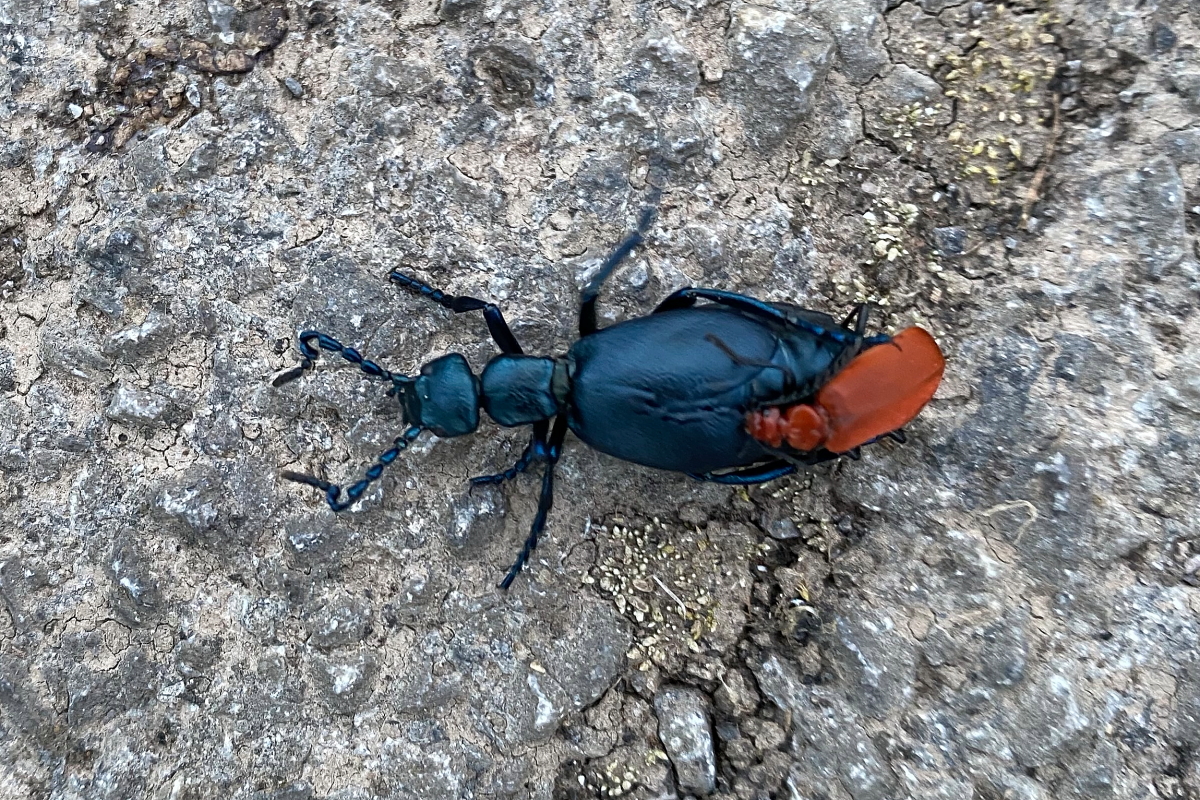
Oil Beetle apparently being attacked by a Cardinal Beetle, Holt Bay © Nigel Milbourne 2026
Saturday 2nd May [A pleasant morning, with rain arriving during the afternoon]
Ben C. kindly contacted me today to let me know he saw his first Hobby of the year at the lake today.
Friday 1st May [Mainly overcast & warm. Brightened up later in the day.]
I enjoyed another fairly late walk this evening in the warm conditions. I saw three Painted Lady butterflies (after 1915 hrs) between the Lodge and Green Lawn, a Common Sandpiper at Holt Bay, and a couple of Great White Egrets, in a list of 31 spp. in two and a half hours. Again, I have yet to see a Hobby – perhaps I should try during the day as they’re moving through. Angler Jeff H. kindly messaged to say he’d seen his first damselfly of the year at the lake, so there may be something for the Hobbies to feed on in the coming days, aside from Chironomid midges and caddisflies (sedge flies to the anglers).