Blagdon Lake storage level was 53% on the 1st September, Bristol Water; cf. 38% in 2025.
The storage level was 53% on 8th September, Bristol Water; cf. 38% in 2025.
The storage level was 52% on 24th September, Bristol Water; cf. 40% in 2025.
Wednesday 30th September [Dry & sunny after overnight rain]
A lunchtime visit , unfortunately, didn’t allow me to spend any time checking through the Teal as I was hoping to, because for the most part they were gathered along Burmah Road and miles away from any decent viewing points. The Barnacle Goose was with the Canada Geese and there were 11 Egyptian Geese. I counted 36 Wigeon and 26 Little grebes today. The eight Lapwings and Common Sandpiper were still around, but there were no new waders to be seen. Two Little and five Great White Egrets were present, including one with what I presume to be a red ring, but today looked decidedly orange (very confusing) all the while I was trying to read it – unsuccessfuly. I noted 32 spp.
Tuesday 29th September [Breezy & mainly sunny]
Unfortunately, I didn’t manage to get to the lake until early evening, but there were definite signs of an influx of wildfowl at long last. As I suspected the other day, there were two Garganey, standing together on Wookey Point tonight, and another increase in the Wigeon count; I made it 30 today. There were lots of Teal that I wasn’t able to ‘grill’ closely due to the distance and light conditions, so there may be more Garganey to find. I saw two groups of Egyptian Geese with a total of at least 15, but possibly as many as 18, two Pintail, a Common Sandpiper, eight Lapwing, two Little Egrets and four Great White Egrets. 38 spp.
Monday 28th September [Lots of sunshine with some cloud around lunchtime]
After not getting to the lake over the weekend, I spent nearly two hours late this morning beside the lake. A Barnacle Goose had joined the Canada Goose flock (not likely to be a migrant), and there were still eleven Egyptian Geese in a separate flock of their own. The Wigeon count had gone up to 15, and I spotted a single Pintail, seven Lapwings and counted 74 Cormorants on Rugmoor Point. The egret count was five Great White and two Little. Other sightings included a welcome Kestrel, a couple of Clouded Yellows, Speckled Woods, Migrant Hawkers and Common Darters still on the wing. 36 spp.
Sunday 27th September
Belated news from Nick P. of his visit today, during which he saw seven Egyptian Geese, three Wigeon, a Yellow-legged Gull, eight Lapwings, a Barnacle Goose, and looking towards Top End, a few more Egyptian Geese, Pintail and more Wigeon. Thanks Nick, all news gratefully received.
Mike Moxon kindly sent me some very interesting information about the red-ringed Great White Egret that has been at Blagdon, after it was identified from photos. The ring is red AHC, that was fitted on 28th April 2025 at Westhay NNR (sex unknown). Subsequent sightings include:
- 1st Sep. 2025 at Cors Caron NR (Tregaron Bog), Ceredigion;
- 28th Feb. 2026 on the River Teifi, Llanfair Clydogau, Ceredigion;
- 10th Apr. 2026 at Catcott, Somerset;
- 19th Apr. 2026 at Cors Caron NR, Ceredigion;
- 15th June 2026 at Cors Caron NR, Ceredigion;
- 11th Aug. 2026 at Goldcliffe Lagoons, Newport;
- 15th Sep. 2026 at Blagdon Lake, B&NES.
This suggests it fits a pattern of summer in Ceredigion, and winter in Somerset, with Goldcliffe used as a staging post. My thanks to Mike and Alison for the heads-up on this one.
Friday 25th September [Sunny spells for much of the day]
I spent a couple of hours at the lake this afternoon and saw the Ruff and five Wigeon in Wood Bay where most of the water birds were gathered around Wood Bay Point. Five Lapwing were still on the point too, but I didn’t manage to pick out the Garganey; it may have been on the far side of the point with the Teal there. The Egyptian Geese were more scattered around Top End today in several small groups, but the total of eleven was the same as the last few days. I noted four Great White and one Little Egret, which has been the norm for a while now – most of them seem to be at t’other place. Two Clouded Yellows crossed my path while I was on foot, but numbers are in decline now it’s getting cooler.
I got a few photos of Alder Tongue Gall at Bell’s Bush barrier, and searched Birch trees there for new galls and leaf mines, but didn’t come up with anything I could identify, other than a Common Green Shieldbug, when I might, perhaps, have expected a Birch Shield Bug.
Thursday 24th September [A fine sunny day]
I stopped over at the lake on the way back from a mid-morning dental appointment, and saw a Garganey that may have been diferent to the one that has been present for a little while. This one gave me the impression that it was a probable male, but was flushed before I saw definitive characters. There were seven Wigeon that were new in, the Lapwing count went up to five, the Ruff was in Wood Bay, and I counted eleven Egyptian Geese. I popped home for a spot of lunch then went back with my camera for the afternoon. 42 spp.
I added a new plant gall to the site list, a Poplar-lettuce Gall that I found on Lombardy Poplar at Long Bay, got a better picture of the Woolly Beech Aphids and this Crab Spider Xysticus sp. climbing the door frame of the Fishing Lodge.

Poplar-lettuce Gall, Long Bay, Blagdon Lake © Nigel Milbourne 2026

Woolly Beech Aphids, Rainbow Point, Blagdon Lake © Nigel Milbourne 2026

Crab Spider Xysticus sp., Fishing Lodge, Blagdon Lake © Nigel Milbourne 2026
Wednesday 23rd September [Early drizzle gave way to sunny spells]
An hour, just before lunch, gave me time for a quick poke around, during which I saw three Lapwings, a Ruff and a Garganey around Wood Bay Point, and eleven Egyptian Geese at Burmah Road. While scanning Top End from Rainbow Point, I saw an adult female Marsh Harrier on Rugmoor Point, which might explain why there were even fewer Teal to be seen at the east end of the lake than the last few days. Man, it’s hard work birding at Blagdon! 32 spp.
I spent some time looking for plant galls and leaf mines, starting with the Beech trees on Rainbow Point, where I found several leaves that had been rolled downwards along their midrib. There were waxy white insects inside which had caused the fold, that were Woolly Beech Aphids. I will probably need to revisit them with a decent camera and macrolens, rather than trying to use my phone in a stiff breeze to have sufficient evidence record them.

Rolled Beech leaf, Rainbow Point, Blagdon Lake © Nigel Milbourne 2026

Woolly Beech Aphids on underside of rolled Beech leaf, Rainbow Point, Blagdon Lake © Nigel Milbourne 2026
Tuesday 22nd September [Misty to start, then a lovely, still, warm afternoon.]
I enjoyed a lovely afternoon at the lake, the birding hadn’t changed, with two Ruff, a Garganey, a Peregrine and 15 Egyptian Geese the highlights. There were still a handful of Clouded Yellow butterflies over the meadows and a few Speckled Woods along the hedges, lots of Migrant Hawkers, plus I noted two moths; the native Dusky Pearl Udea prunalis, and the migrant Rush Veneer Nomophila noctuella, the latter in fairly good numbers in the vicinity of the Top End hide. From there, I went to look at a Black Poplar, a rarely common tree, because I wanted to see if I could find any plant galls on it. On the way I ended up chatting with Mark H. for a couple of hours, and by the time I got to the Poplar the sun was dropping towards the horizon. I may have found signs of Poplar-buttercup Gall, caused by an aphid Thecabius affinis, but will need to go back and check it out a bit more thoroughly in daylight, in order to record its presence. There are several other galls that form on Black Poplar too, so it’s worth me spending more time looking. I also photographed a leaf mine on Hawthorn in the hedge I followed, that I believe is that of a micromoth, the Hawthorn Leaf Miner Phyllonorycter corylifoliella (to be verified). The galls and leafmines are quite fertile ground for more recording at the lake at this time of year. 41 spp.
Monday 21st September [A lovely warm, sunny, day.]
I managed to grab half an hour at the lake as the sun went down, so I didn’t really have enough time and light to make my visit thorough. However, a Shelduck on Wood Bay Point was a welcome surprise. The two Ruff and seven Egyptian Geese were still present, but it was just too dark to go through the ducks one by one to identify them. Maybe tomorrow? 29 spp. While I was at Woodford Lodge earlier in the day, I learned that Blagdon will be pumped again soon – perhaps we might yet welcome a few more migrants? At the moment my year list at BL is just 119 spp., and I know 127 spp. have been recorded so far.
Sunday 20th September [Grey to start, then brightening into a lovely autumnal afternoon.]
I went to the lake early in the afternoon and saw the two Ruff I found on Friday, and eventually spotted the Wheatear found by Nick P. this morning; it was in front of the hide feeding along the foreshore. Scanning along the southern shore from the hide I also saw a Lapwing with a group of loafing waterfowl at Burmah Road and ten Egyptian Geese in Wood Bay, 31 spp. There’s been no update from BW on the water storage levels of the ressies since the 8th of the month, but Blagdon has changed very little since then.
One of the Great White Egrets at Top End looked as if it had an orange leg ring on, so I immediately became very interested, but after preening it flew and landed in front of the hide but half way across Top End. At that point, I realised the ring wasn’t orange at all, it was red. It was a trick of the light and a bit unsettling. As a result, the apparent sighting of an orange ring on a GWE that I saw on 11th September must now be in doubt, perhaps it was the same scenario, although that bird was seen initially from a distance but then flew to where today’s bird landed, and then on to Wookey Point where it still appeared to be orange. What a shame I couldn’t read any of the symbols on it!
Friday 18th September [Mainly dry, with some sun & occasional light showers.]
I spent an hour and a half at the lake during the late afternoon and counted the following species: Canada Goose 2, Egyptian Goose 12, Pintail 3, Pochard 1, Tufted Duck 59, Little Grebe 21, Ruff 2, Little Egret 4, Great White Egret 4 (inc. the red-ringed bird again), Kestrel 1, and Hobby 1. It was nice to see a few more Tufted Duck have arrived, as well as the two Ruff. I couldn’t spot the Garganey, but the light wasn’t great for looking at ducks up to 500 metres away. 42 spp.
Thursday 17th September [Early rain gave way to a changeable & breezy day]
A late night, and a visit to the optician this morning, gave me little spare time to get down to the lake today, although someone sent a decent report to Avon Birds, which included a few counts and a rare Marsh Tit record.
For my part, this evening, I’ve been looking at a couple of my BTO News magazines and the latest Waterbirds in the UK report for 2024/25 which I and a regular team of volunteers contribute monthly Wetland Bird Survey (WeBS) counts to all year round, as Blagdon Lake is one of 3,435 Core Sites included. Headlines highlighted a record low index for Bewick’s Swan, since monitoring began in 1966/67, with a 25-year trend of -96%, but the non-native Egyptian Goose had a record high index with a 10-year trend of +120%. Shoveler numbers have almost doubled in England, which has driven a 25-year trend of +82%, with most other duck species stabilising, although the 10-year trends for Mallard at -16%, Goldeneye at -20%, Tufted Duck at -22% and Pochard at -33% continue to decline. Unsurprisingly, Cattle and Great White Egrets saw record high indices, and Little Egret showed a strong increase, with a 10-year trend of +44%. I will dig deeper into some of the detail in future diary entries. If you wish to take a look at the report online it can be found at: www.bto.org/webs-reporting.
Wednesday 16th September [Mainly dry with sunny spells]
I managed an hour and a half at the lake this morning, before going back in the evening to join Daniel H. and Mark H. with a few of our regular volunteers in a few hours of bat trapping until approx 0100 hrs, just as the drizzle set in. I counted eight Egyptian Geese, five Great White and one Little Egret, saw no waders and noted a handful of Tufted Duck. It seems likely that the Great White Egret that I saw last Friday with an orange ring has come from Latvia! There was another today with a red ring which, I think, means it is a local bird ringed on the Somerset Levels. Unfortunately, once again, I was unable to read the ring details. 29 spp. The bats were a bit more cooperative, although we didn’t catch any of our target species, the Nathusius’ Pipistrelle, that we were hoping to tag. In five Harp Traps with lures run from dusk until we packed up, we caught:
- Soprano Pipistrelle;
- Whiskered 1f;
- Daubenton’s;
- Serotine 1;
- Brown Long-eared 1.
/more details to follow.
Monday 14th September [Some early drizzle & dry with sunny spells for the rest of the day]
Phil D. and I did the WeBS count this morning between 1005 & 1300 hrs after chats with Mark, Jeff and Leyla while we were standing at the south end of the dam. Anyway, the water level was probably still on 53% despite some recent rain. I did the dabbling ducks (mostly still in moult) and Phil did all the rest! We saw a tern from our start point which we concluded was a, probable adult, Common Tern going into winter plumage, but it quickly flew off up the lake and out of view. We also saw a Kingfisher there which flew into and out of the trees at Cheddar Water, hovering over the water without diving in on this occasion. We didn’t see a single wader during the count, but I did refind the Garganey among the Teal at Burmah Road. The, probable adult female, Peregrine was still present today and made a pass over the teal on at least one occasion, and we also had a Red Kite go over. Count details as follows: Canada Goose 2, Mute Swan 42 (inc. 9 juvs.), Egyptian Goose 16, Garganey 1, Shoveler 21, Gadwall 102, Mallard 391, Domestic Mallard 1, Pintail 3, Teal 245, Tufted Duck 15, Moorhen 19, Coot 225, Little Grebe 28, Great Crested Grebe 13, Common Tern 1, Black-headed Gull 140+, Herring Gull 25+, Great Black-backed Gull 6, Lesser Black-backed Gull 11, Cormorant 4, Little Egret 5, Great White Egret 6, Grey Heron 7, Red Kite 1, Buzzard 1, Kingfisher 1, Peregrine 1, Grey Wagtail 2. I also counted at least 7 Clouded Yellows. 43 spp.
Sunday 13th September [A dank & dismal autumnal day]
The birding at Blagdon continues to be absolutely dire. Chris P. saw a Common Sandpiper on the dam this morning, and I didn’t even see that! The Egyptian Goose count had gone down to ten, and there were six each of Grey Heron and Great White Egret. I only noted one Little Egret. However, an adult Peregrine in the pines at Indian Country was a bit of a ‘Brucie’ bonus. 32 spp. We’ll do the WeBS count tomorrow.
Friday 11th September [Dry & sunny]
I had just over an hour at the lake, late this afternoon, as things turned out. Unfortunately, there wasn’t any real change in the birdlife to be seen. I picked out a Common Sandpiper, eleven Egyptian Geese, two each of Little and Cattle Egrets, plus eight Great White Egrets, one of which had appeared to have an orange ring on its left leg, but I was unable to read it. There were very few birds at Top End, and even more polythene spread about the place, so I guess it was mainly down to continued disturbance. 29 spp.
Thursday 10th September [Increasingly cloudy, but dry until late evening.]
We were supposed to be bat trappping this evening, but the weather forecast forced a cancellation. Just as well, because when I arrived at around 1910 hrs the drizzle swept in and it quickly got wet with visibility suffering as a result. I didn’t see the Greenshank, or any other waders, but counted eleven Egyptian Geese and four Great White Egrets. The expanse of polythene sheeting at Top End has increased significantly since my last visit on Tuesday, so I guess the disturbance to waterfowl hasn’t diminished in the intervening period. Maybe, I’ll spend some more time tomorrow looking for plant galls and invertebrates until things settle down a bit. 26 spp.
Tuesday 8th September [Sunshine & showers]
I had a somewhat disappointing swing by the lake at lunchtime. Anglers were in front of the Lodge, and workers in hi-viz orange jackets were laying plastic sheeting at Top End (more about that another day). Consequently there were very few birds, and those that had stayed on the lake were gathered at Burmah Road – a long way from the hide. I could see THE Greenshank was there, but I saw no other waders, and lots of the wildfowl had moved on leaving a few bits and pieces, mainly Teal, but not the number we’d expect at this time of year with the low water level – one of the reasons for the the site SSSI designation. The rain wasn’t exactly helping my mood by this point either! I’ll admit to feeling pretty fed up with the situation, so made my way back home, only to realise I’d left my glasses in the Top End hide. Back I went, and while I was opening the Lodge entrance gate I leaned down to unhook and shut it behind me, and saw a great congregation of what I thought were wasps at first. Closer inspection, revealed that they were bees, and some appeared to be coming out of holes in bank. There were possibly as many as a hundred flying too and fro over the almost bare ground, but what were they up to? I had my camera but only a 300mm lens with 2x converter on it; hardly ideal for photographing them, but I wanted to try and record what I was witnessing nevertheless, so spent about half an hour watching and pressing the shutter to get some behavioural and ID shots. It turns out (thanks to Steven Falks’ Field Guide to Bees of GB & Ireland) that there was an emergence of female Ivy Bees Colletes hederae taking place, now that the sun had come out. This was accompanied by dozens of smaller males zig-zagging around over the area trying to mate with the females as they appeared. It was quite an extraordinary sight! I’ve seen the species at the lake previously, but feeding at Ivy flowers rather than emerging as adults. This species is a newcomer to Britain, being discovered in Dorset during 2001, but is spreading rapidly north and west. 33 spp.

Newly emerged female Ivy Bee, Blagdon Lake © Nigel Milbourne 2026
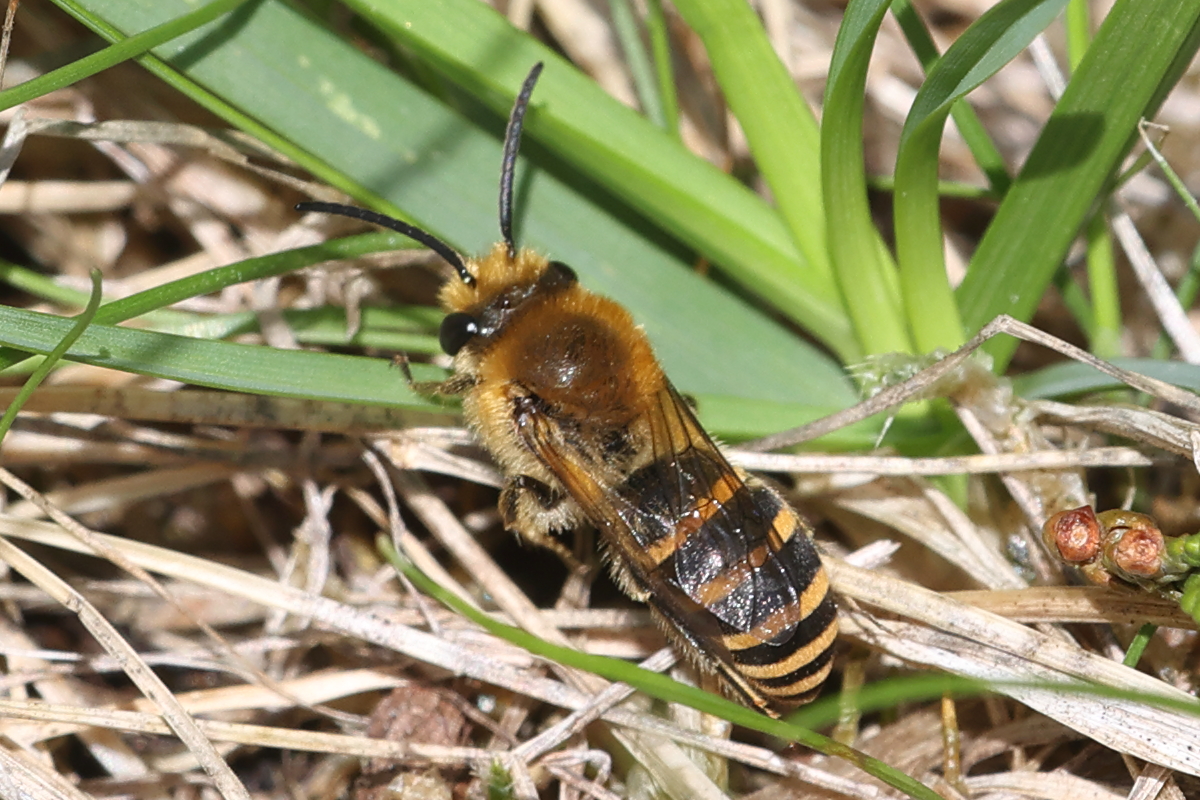
Recently emerged Ivy Bee, Blagdon Lake © Nigel Milbourne 2026
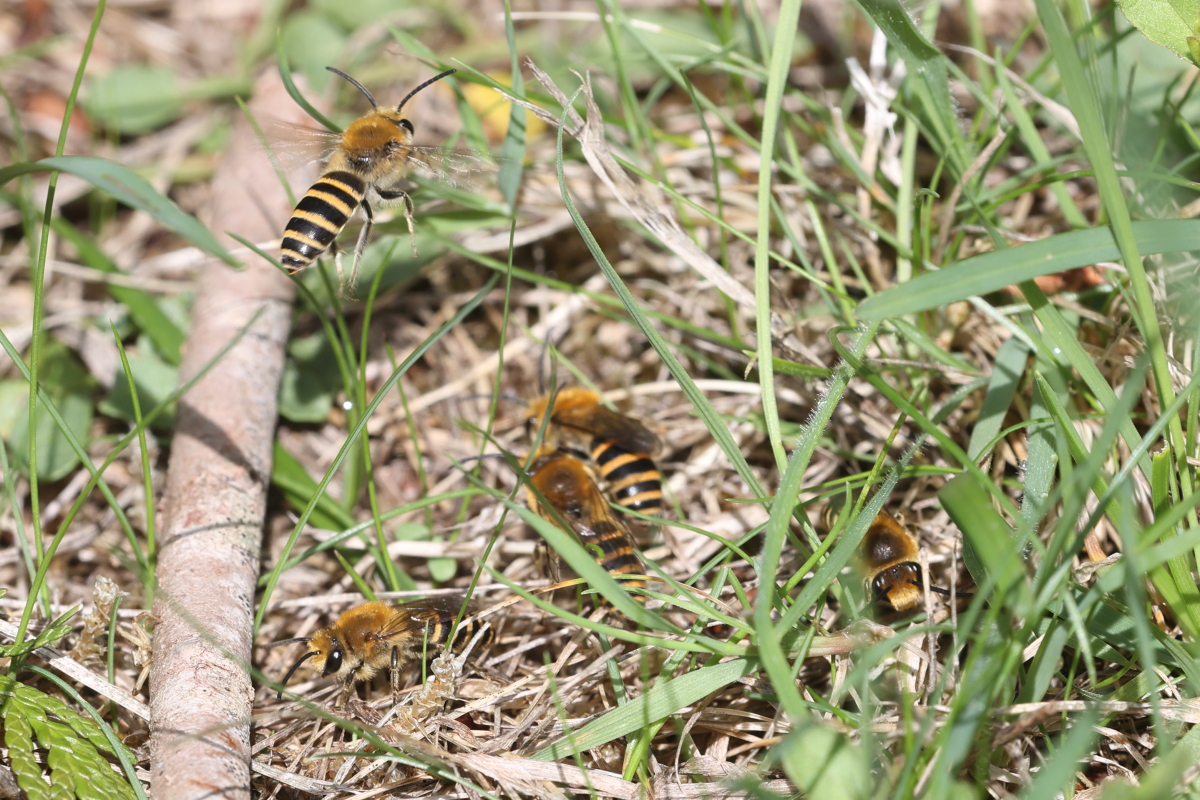
Emerging female Ivy Bees with a smaller male hovering above them, which gives a fair impression of the overall scene that was spread over a square metre or so of ground behind the open gate. Many of my pictures of the emerging females were ‘photo-bombed’ by out of focus, hovering, males – a problem compounded by the shallow depth of field afforded by a long lens compared to lenses that I would otherwise have chosen for the job.
Blagdon Lake © Nigel Milbourne 2026
Monday 7th September [Breezy, with sunny spells.]
The Lodge, dam and Butcombe Bay areas were absolutely rammed, a film crew was on site, something to do with Dawn French I was told. A Greenshank was still at Top End with a solitary sandpiper – a Green Sandpiper, ho ho! I saw three Cattle Egrets at Wood Bay, and five Tufted Duck in front of the Lodge, one of which looked interesting, but I feel sure it was a Tufted Duck. I spent some time chatting with angler Jeff H. talking about the lack of Tufted Duck, and he came up with an interesting theory about the seeming lack of Lesser Waterboatmen Corixa punctata, a favourite food item of Tufteds, in the shallow margins of the lake; he thinks the water may have got too warm for them during the hot weather, and that they may have moved out en masse, which is quite plausible given how shallow the lake is. Another posssibility is that breeding failed. 35 spp.
Sunday 6th September [Sunny]
There were still plenty of anglers at the dam end of the lake, nevertheless Top End was very quiet due to two juvenile Marsh Harriers that spent a while this afternoon roaming around the lake. I last saw them go down at the dam end, perhaps into one of the two small reed beds, while watching from Rainbow Point with Nick W-B. We also saw a juvenile Hobby hunting insects over the lake from Top End towards the dam. At Top End there was a lone Greenshank and two Cattle Egrets at Wood Bay. 33 spp.
Saturday 5th September [A fine, sunny, day.]
I went to Bridgwater this morning bright and early to do the Parkrun, a new one for me. I didn’t get down to the lake to look at the birds during the afternoon before going down to meet Daniel H. and Mark H. for an evening of bat trapping at Butcombe Bay. I ran a trap at the Spillway and caught:
- Soprano Pipistrelle 3m, 2f
- Daubenton’s Bat 1m
- Whiskered Bat 1m, 1f.
Several other traps and nets were run by a mix of Vincent Wildlife Trust and Avon Bat Group members. As I packed up at 0100 hrs, helped by Daniel, he got a call to say the others had caught a Nathusius’ Pipistrelle at long last – just as it started to rain. The aim of the evening was to try and catch as many Nathusius’ as we could to fit a new type of tracker that weighs just 0.3 g and potentially gives about a months worth of data – the latest ongoing project into the migration of bats into and out of the UK. Daniel informed me later that he fitted a tracker to the Nathusius’ Pipistrelle. Hopefully, we’ll have some data to share in due course.
Friday 4th September [Cloudy & windy, but remaining dry.]
I had a birding walk from home to Top End hide and back this afternoon. The most surprising bird was a late Swift at Green Lawn. I had a good look at it, because the possibility of a Pallid Swift crossed my mind, and was convinced it was a Common when it flew directly overhead. There were 11 Egyptian Geese today, and with the water coloured and a little bit up at Top End, I only picked out three Pintail and three Greenshank through my binoculars, although there may have been another ‘shank up towards Burmah Road that I saw on the way past but couldn’t see from the hide. There were lots of angling boats out at the dam end practising for a match, I believe, to be held tomorrow. Other than that, I saw plenty of hirundines of all three familiar species, and the usual Great White and Little Egrets. I recorded and photographed a plant gall on Field Maple at Cheddar Water hedge, that friend Una Garland recorded in 2015, that is caused by the mite Aceria macrochela and called Solitary Maple Leaf Gall by some authorities. 32 spp.
Wednesday 2nd September [Rain all morning]
I stopped off at the lake on the way back from the dentist around midday but it was a bit of a waste of time; there were men in bright orange suits wandering around at Top End. It took me a while to work out what was causing the disturbance until they walked out onto the lake bed from the trees. I saw four Greenshank, but gave up with the ducks as they were all over the place. I counted five Egyptian Geese in Holt Bay on the way through to the dam end, but didn’t bother spending too much time there either as there was quite a lot of angling activitiy.
I went back again mid-afternoon and recorded ten Egyptian Geese, at least 240 Herring Gulls on Tiny’s Shallow (Point), three of which I managed to read the rings as Yellow B=A, Orange L=X, and White A=H (all adults) and slightly fewer, but nevertheless impressive number of Lesser Black-backed Gulls, one of which was also ringed as Black A=N (subadult). I’ll get all of these off to Pete Rock, but I suspect they’re going to be local breeders. 32 spp.
Tuesday 1st September [Early rain followed by sunny spells & showers.]
I walked from Blagdon to Compton Martin with friends across the fields this morning, then went down to the lake late this afternoon. Among the increasing number of waterbirds, there were just three Greenshank to see from the Top End hide, and I counted 13 Egyptian Geese and nine Pintail, but I couldn’t spot the Garganey in the time I had available. On the way back home, I checked a few bushes for new galls and found Violet Bramble Rust, Hawthorn Button-top Gall, and Alder Vein Angle Gall that I took some (phone) pictures of to add to the Plant Galls & Causers gallery. 35 spp.