Historical Rare Birds
Keith Naylors excellent research work carried out into historical British rare bird records (pre-1950), and during the interim period 1950-57 before the British Birds Rarities Committee (BBRC) was formed, was subsequently adopted by the BBRC. Keith became a consultant to the British Ornithological Union Records Committee (BOURC) in 2011. His website is an amazing resource, and I have no hesitation in recommending you have a look at it if you are interested in old rare bird records. I have provided the official citation and link to it in the bibliography at the bottom of this page.
The 1916 Little Bittern record, I have to confess, has always puzzled me, given the sighting dates for what is essentially a rare summer visitor. Keith’s comment seems to be a reasonable one in the circumstances, unless the bird was, perhaps, injured or suffering in some way that prevented it from embarking on a long migration flight. However, although Carr notes that it was seen on several occasions, there was no mention of a physical injury to my knowledge.
I recommended Richard Mielcarek take a look at Keith’s website, as he was putting together The Birds of Avon, An Annotated Checklist, and we have been comparing our various bits of research, mine into Blagdon Lake bird records, and Richard into those of the wider Avon ornithological recording area. The records below have been removed from my site bird list and parked as historical records deemed ‘not proven’ as adopted by the BBRC, but to his credit Richard is seeking clarification on the decisions relating to Great Snipe. He has shared some recent correspondence with me suggesting that there is an intention to review Bernard King’s records again, so it is possible that they may yet be re-instated sometime in the near future. For my part, I found it a little strange that the records, were deemed ‘not acceptable’ retrospectively, despite the considerable experience of Bernard King, and the acceptance of the identification by no less an authority than Bernard Tucker, just because Great Snipe are said to be “extremely rare on the west side of Britain”. It seems to me that just about anything is possible with the extralimital occurrences of birds, and these documents ought to be left in the local historical record. So, I have included them here, together with some of my research evidence, even though we have to accept the BBRC decision for now.
Little Bittern 1916 Avon Ubley, seen, November to December.
(Report of the Wells Natural History Society 1916; Palmer & Ballance, 1968; R. Mielcarek, 2019 An Annotated Checklist [Avon] 2nd ed.). [KAN].
History – Palmer & Ballance (1968) say: ‘Ubley, November – December (WSR).’
Comment – Rather a late date. Not known to have been seen by a competent authority. No identification details for a sight record. Not acceptable.
Great Snipe 1949 Avon Blagdon Reservoir, Somerset, seen, 6th March.
(H. H. Davis & P. J. Chadwick, Ornithological Notes Bristol District 1949: 36; F. L. Blathwayt, Report on Somerset Birds 1949: 22; B. King, British Birds 45: 35-36).
[KAN].
History – H. H. Davis & P. J. Chadwick (1949) in Ornithological Notes Bristol District, p. 36, say: ‘A large snipe, undoubtedly C. media, flushed three times in quick succession, Blagdon Reservoir, Mar. 6 (B.K. & R.H.P.), and another (possibly the same) put up a dozen times within an hour at clay-pits adjoining Cheddar Reservoir, Apr. 3 (B.K.). Details from B.K. show that on all occasions the bird rose silently, alighting again almost immediately, and appeared larger than Common Snipe (C. gallinago), some of which were present on each date, and was noticeably slower and more direct in flight. At both Blagdon and Cheddar the conspicuously white outer tail-feathers were noted but only at the former was it possible to detect so important a character as the heavily barred flanks. The Blagdon bird, when viewed at 50 yards’ range near the water’s edge, was seen to waddle into cover with the half-walking, half-running gait described in The Handbook (Vol. IV. p. 193).’
F. L. Blathwayt (1949) in the Report on Somerset Birds, Vol. XXXVI. p. 22, says: ‘Single bird seen, Blagdon Reservoir, Mar. 6; a large Snipe with typical bill; head darker than upper parts, with pale brown face and neck; a little white showing on the secondaries; conspicuously white outer tail feathers, and under parts well barred. With a gait half-walking, half-running it was seen on one occasion to waddle in duck-like manner, and to conceal itself in short grass close to the water’s edge. At no time did the bird make any call. Mode of flight was somewhat heavy, with no twisting as in Common Snipe. It was last seen gliding into ploughed land well away from the reservoir (B.K. & R. H. Poulding).’
Bernard King (1952) in British Birds, Vol. XLV. pp. 35-36, says: ‘Mr. Bernard King has sent us detailed accounts of single Great Snipe (Capella media) seen on March 6th, 1949, at Blagdon, on April 3rd, 1949, at the clay pits, Cheddar, and on December 27th, 1950, at Blagdon, Somerset; on the first occasion Mr. King was accompanied by Mr. R. H. Poulding and on the last by Mr. M. J. Wotton. The species is described by H. H. Davis (A revised list of the birds of the Bristol District, p. 256) as a “very rare vagrant” to the district. A search of available county reports shows the following other records for these years: 1949 – one, Yorkshire, September (two possibles, Devon/Cornwall border, August). 1950 – one, Warwicks, May; one, Berks., September; one, Sussex, September.’
Comment – Spring records are extremely rare, even more so on the west side of Britain. Not acceptable.
Great Snipe 1950 Avon Blagdon Reservoir, Somerset, 27th December.
(H. H. Davis & P. J. Chadwick, Proceedings of the Bristol Naturalists‘ Society 28: 188-189; B. King, British Birds 45: 35-36; F. L. Blathwayt, Report on Somerset Birds 1950: 19). [KAN].
History – H. H. Davis & P. J. Chadwick (1950) in the Proceedings of the Bristol Naturalists‘ Society, Vol. XXVIII. pp. 188-189, say: ‘One identified, Blagdon Res. (Ubley end), Dec. 27. The bird, flushed three times, was seen by B.K. and M.J.W., who report that on each occasion it rose without calling, and with flight more direct than in Common Snipe. B.K. records that it looked larger than Common Snipe and that the outer tail-feathers were conspicuously white; also that when first flushed it alighted about 35 yds. distant, and in full view; thus enabling both observers to note (with telescope) the heavily barred flanks, and shorter looking bill than in C. gallinago. Detailed pencil sketches by M.J.W. confirm the identification.’
Bernard King (1952) in British Birds, Vol. XLV. pp. 35-36, says: ‘Mr. Bernard King has sent us detailed accounts of single Great Snipe (Capella media) seen on March 6th, 1949, at Blagdon, on April 3rd, 1949, at the clay pits, Cheddar, and on December 27th, 1950, at Blagdon, Somerset; on the first occasion Mr. King was accompanied by Mr. R. H. Poulding and on the last by Mr. M. J. Wotton. The species is described by H. H. Davis (A revised list of the birds of the Bristol District, p. 256) as a “very rare vagrant” to the district. A search of available county reports shows the following other records for these years: – 1949 – One, Yorkshire, September (two possibles, Devon/Cornwall border, August). 1950 – One, Warwicks, May; one, Berks., September; one, Sussex, September.’
F. L. Blathwayt (1950) in the Report on Somerset Birds, Vol. XXXVII. p. 19, says: ‘Single bird seen, Blagdon Res., Dec. 27. After being flushed, bird settled in the open, thirty-five yards away. Good views obtained of barring on breast and flanks, the ground colour of which was buff. Large size, snipe-like bill (looking shorter than in Com. Snipe) and conspicuous white outer tail feathers were noted. The bird gave no call and was flushed twice before flying into meadow land nearby. Detailed pencil sketches by M. J. Wotton confirm the identification.’
Comment – December (winter) records are probably misidentified. Extremely rare on the west side of Britain. Not acceptable.
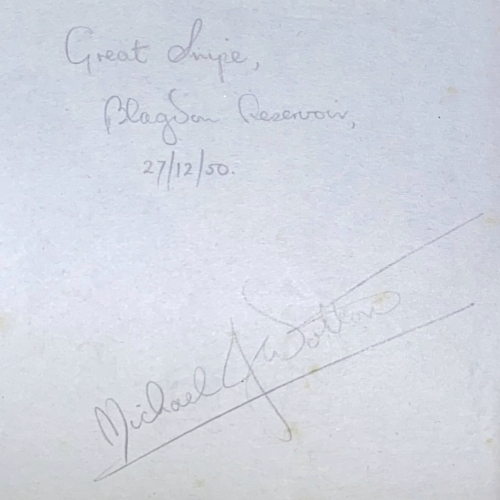
My Addendum – I own four bound volumes that belonged to Bernard King viz. Reports. Birds of Somerset. 1924-33, 1934-41, 1942-6, 1947-51. In the volume covering the years 1947-51, I came across this original pencil drawing made by Michael J. Wotton, signed and dated 27th Dec. 1950 that had been bound into Bernard’s copy of the report:

I had to light the photo of the signature on the drawing differently to bring out the best of it:
Then a few pages later, also bound into his copy of the report, is a card sent to Bernard and dated 3rd March 1950, that reads as follows: “I am sorry that action has once more been very much delayed. I have now had a chance to talk to Mr. Tucker about your record of Great Snipe and he agreees that your identification is correct. He does not expect to be publishing the record in full in B.B., but is quite prepared to back it for publication elsewhere. Incidentally, I am afraid he is in very poor health, otherwise you might have got this answer many weeks ago. Thank you for your records of late terns in Somerset and for the parts of the dead Arctic.” Signed by editorial assistant, J.D. Wood.
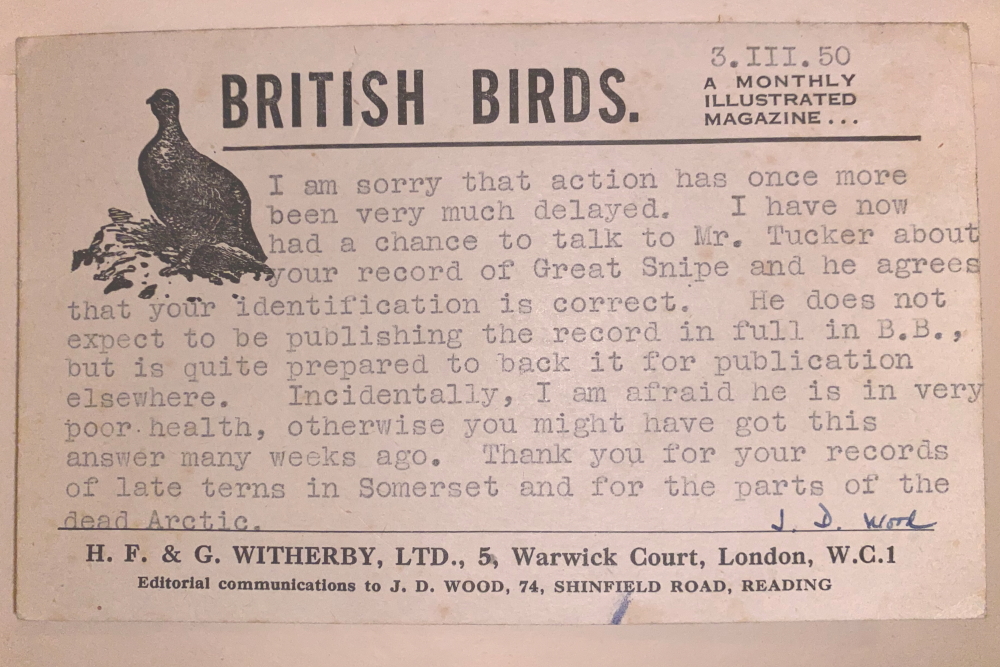
As it turned out, the Great Snipe records were published in the Notes section of British Birds Vol. 45, as shown in Keith’s review of the 1950 record above.
Bibliography (sources of information):
-
- Naylor, KA 2025 Historical Rare Birds <https://www.historicalrarebirds.info/>
- King, B.J. Ex libris. Reports. Birds of Somerset. 1924-51 (4 vols.).
Last update: 20th February 2025